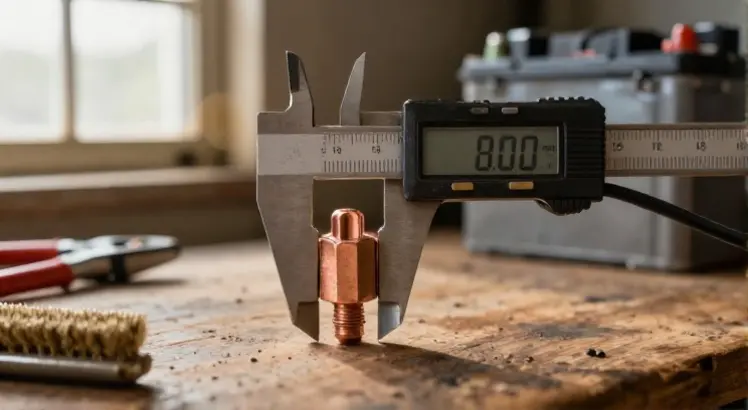
If you are repairing a battery cable or building a custom power setup, you quickly run into the question: what size are battery lugs? Battery lugs are the metal connectors that attach thick battery cables to terminals, studs, or bus bars. Getting the size right, both the wire entry barrel and the mounting hole, is critical for a safe, low-resistance connection. This guide explains standard lug sizes, how to measure your cable, and how to match lugs to different battery terminals.
Why Battery Lug Size Matters

TKDMR 160Pcs Copper Wire Lugs AWG2 4 6 8 10 12 with Heat Shrink Set, 80Pcs Battery Cable Ends Ring Terminals Connectors Tubing Assortment Kit
Check PriceBattery lugs are not one-size-fits-all. A lug that is too small for the cable will be impossible to install or will have loose strands that invite corrosion. A lug with a stud hole that is too large rocks on the terminal and creates high resistance, leading to voltage drop and heat buildup. On the other hand, a hole that is too tight will not seat fully, causing a weak connection. Choosing the correct battery lug size ensures maximum current flow, minimal heat, and a long service life for your electrical system.
In everyday automotive use, you might encounter these lugs when upgrading an audio system, replacing a corroded ground cable, or maintaining a marine battery bank. The right size depends on two simple measurements: the cable gauge and the terminal stud diameter. Once you understand those, picking the correct lug takes only seconds.
How Battery Lug Size Is Measured

TKDMR 10 PCS 1/0 AWG – 3/8″ Battery Cable Lugs Copper Wire Ring Terminals | UL,Heat Shrink Cable Ends,Wiring Connector Terminal End,Electrical Crimp Connectors,Lug for 1/0 Gauge Wires
Check PriceBattery lug size is actually defined by two separate dimensions. First is the barrel size, which must match the copper cross-section of your battery cable. Second is the ring terminal hole, often called the stud size, which must match the mounting bolt or battery post. Confusing these two is a common mistake.
Cable Gauge (AWG) and the Lug Barrel
Battery cables are measured in American Wire Gauge, or AWG. The smaller the AWG number, the thicker the wire. For example, 4 AWG cable is much thicker than 10 AWG. Each battery lug is stamped or labeled with its compatible wire gauge range, such as 6 AWG or 1/0 AWG. The barrel of the lug must be large enough to accept the stripped copper conductor snugly, without forcing strands to bunch up.
When the cable gauge is unknown, you can measure the diameter of the copper conductor and compare it to a standard AWG wire gauge specification chart. Most automotive battery cables are between 6 AWG and 2 AWG for starters, while heavy-duty trucks, winches, and inverters often use 1/0 AWG or larger. Always size your lug to the actual copper diameter, not the insulation outside diameter.
Stud Hole Diameter
The ring portion of the lug has a drilled hole that slips over a stud or bolt. Common stud sizes on automotive and marine batteries are 1/4 inch, 5/16 inch, and 3/8 inch. Some heavy equipment uses 1/2 inch studs. Selecting a lug with the correct stud hole prevents movement and guarantees a full-contact seat against the terminal pad.
It is worth noting that side-post batteries use a different style entirely, but when you add a ring terminal to a side-post adapter, the stud size is often 3/8 inch. If your battery has a standard top-post clamp, you may be crimping a lug onto the cable that then bolts to a military-style terminal or a distribution block. In those cases, you must match the block’s stud.
Common Battery Lug Sizes by Cable Gauge

264 PCS AWG 8-2/0 Copper Battery Cable Ends & Heat Shrink Tubing | 120Pcs Heavy Duty Ring Terminals, 144Pcs 3:1 Shrink Tubing, AWG 8 6 4 2 1/0 2/0 Awg, Auto Marine Wire Connectors
Check PriceTo make selection easy, here is a quick reference of the most widely used battery lug sizes and their typical stud holes. Keep in mind that the same wire gauge lug can come with different hole sizes, so always check both dimensions when ordering.
- 8 AWG lugs – common stud sizes: 1/4 inch, 5/16 inch; often used for accessory power leads, small fuse blocks, and motorcycle batteries.
- 6 AWG lugs – common stud sizes: 1/4 inch, 5/16 inch, 3/8 inch; found on many standard car battery ground cables and marine electronics.
- 4 AWG lugs – common stud sizes: 5/16 inch, 3/8 inch; popular for high-output alternators, amplifier power wires, and mid-size diesel engines.
- 2 AWG lugs – common stud sizes: 3/8 inch, 1/2 inch; used in truck starting circuits, RV house battery banks, and large inverters.
- 1/0 AWG lugs – common stud sizes: 3/8 inch, 1/2 inch; the go-to for heavy-duty winch motors, plow setups, and dual battery systems.
- 2/0 AWG and 4/0 AWG lugs – common stud sizes: 3/8 inch, 1/2 inch; mainly commercial vehicles, large marine battery switches, and industrial equipment.
Notice that 3/8 inch is the most versatile stud hole. Many aftermarket battery terminals and marine battery posts use this size, which is why 3/8 inch ring lugs are so widely stocked. However, always double-check your terminal or stud before you crimp.
Types of Battery Lugs and Their Sizes

1/0 AWG/Gauge – 3/8″ Battery Cable Lug Copper Connector Wire Ring Terminal | AIRIC,UL,1/0 AWG 3/8″,10Pcs,Heat Shrink Cable End,Electrical Wiring Crimp Connectors,Copper Battery Lugs,Wire Ring Terminals
Check PriceBattery lugs come in several styles, and the physical size can vary slightly depending on the material and design. Understanding these types helps you avoid picking a lug that physically cannot fit in a tight battery box.
Standard Copper Tube Lugs
These are tinned copper barrels with a flat ring tongue. They are the most common style for automotive and marine use. Sizes follow the AWG chart above. The overall length of a 2 AWG copper lug is roughly 1.5 to 2 inches, while a 4/0 AWG lug can be over 3 inches long. Make sure you have enough clearance around the battery post.
Flag and Right-Angle Lugs
Sometimes a straight lug forces the cable to bend sharply. Flag lugs or right-angle lugs solve this by turning the ring 90 degrees. They are available in the same wire gauge and stud hole combinations but have a lower profile. Flag lugs are popular in side-post battery applications and tight engine bays.
Heavy-Duty Marine Lugs
Marine lugs have a thicker wall and a heavy tin plating for corrosion resistance. They are often labeled for 6 AWG through 4/0 AWG. The stud hole is almost always 3/8 inch or 5/16 inch, matching marine battery switches and bus bars. The barrel size remains identical to standard AWG measurements, but the extra thickness can demand a more powerful crimping tool.
How to Choose the Right Lug for Your Vehicle

Twidec/130PCS Copper Wire Lugs AWG 2 4 6 8 10 12 14 16 Gauge Battery Cable Ends,Ring Terminals Connectors,Copper Ring Terminals,Battery Terminals Connectors Kits with Heat Shrink N-067-130PCS
Check PriceWith so many options, here is a straightforward three-step process to nail the correct battery lug size every time. This method works whether you are working on a car, truck, boat, or RV.
First, determine your cable gauge. Look at the insulation jacket; most battery cables print the AWG number along the length. If it is faded, strip a small section and measure the bare copper diameter. Compare it to an AWG chart or take a known-size lug and test-fit the strands. Second, identify the stud or bolt diameter on the battery terminal or distribution point. Use a caliper or a simple nut-and-bolt gauge. Third, pick a lug that matches both measurements, and make sure the lug style fits the available space without forcing a sharp cable bend.
When shopping, invest in quality connectors. Poorly made lugs with thin walls crack under crimping pressure and generate excess heat. High-quality battery cable lugs use seamless copper tubing and thick tin plating, which resist corrosion and maintain low electrical resistance over time.
Installing Battery Lugs: A Quick Overview

150pcs Battery Cable Ends, Copper Wire Lugs Assortment Kit AWG 2 4 6 8 10 Gauge – 70Pcs Battery Cable Lugs Ring Wire Terminal Connectors and 80Pcs Heat Shrink Tubing Kit for Marine Electrical Supplies
Check PriceOnce you have the right size, a secure installation is the next step. A loose crimp is just as bad as the wrong size lug. The goal is a cold weld between the copper strands and the lug barrel, achieved with a dedicated crimping tool, not a pair of pliers.
Strip the insulation back just enough to fill the barrel completely without leaving bare copper exposed. Slide the lug on, place it in the correct die of a crimper, and apply even pressure. Many DIYers find a hammer crimper adequate for occasional jobs, but a hex-style hydraulic crimper delivers the most professional result. For a detailed walkthrough, learn how to crimp battery cable lugs with the right tools and techniques.
Finish the job with adhesive-lined heat shrink over the barrel to seal out moisture. This step is especially important in marine and under-hood environments where road salt and humidity accelerate corrosion.
Frequently Asked Questions

PEASUG Copper Wire Lugs 130Pcs, AWG 2 4 6 8 10 12 Gauge Battery Cable Ends with 66Pcs Heat Shrink Tubing Set, 64Pcs Ring Terminals Connectors Assortment Kit for Marine, Automotive, Cables, Appliances
Check PriceWhat is the most common battery lug size?
For car and light truck battery cables, 6 AWG and 4 AWG lugs with a 5/16 inch or 3/8 inch stud hole are the most common. Marine and heavy-duty applications typically use 2 AWG to 1/0 AWG lugs with a 3/8 inch hole. Always measure your specific setup because OEM terminals can vary.
Can I use a lug with a larger stud hole than my terminal?
Technically you can, as long as you use a flat washer that is larger than the hole. However, a properly sized lug will always deliver better surface contact and less resistance. Using an oversized hole is a temporary fix, not a permanent solution. The lug can shift under vibration and eventually loosen the connection.
Do battery lugs come in metric sizes?
Yes. In European and Asian vehicles, you may encounter metric stud sizes like M6 (roughly 1/4 inch), M8 (5/16 inch), or M10 (3/8 inch). Many lugs are dual-labeled, for example 5/16 inch (M8). Always check whether your lug is specified in metric or SAE to avoid a sloppy fit.
How do I know my cable gauge without markings?
Strip a short length of insulation and measure the diameter of the copper bundle with a digital caliper. Compare the measurement to an AWG chart. For example, a solid copper bundle diameter of about 0.162 inches indicates 6 AWG, while 0.204 inches indicates 4 AWG. When in doubt, take the cable to an auto parts store and test-fit a couple of lugs.
Can I reuse old battery lugs?
Reusing lugs is generally not recommended. The barrel has already been deformed around the old cable, so a new crimp will never be as tight. Cutting off the old barrel and crimping fresh lugs is the safest and most reliable approach. The small cost of new lugs is worth the peace of mind.
Conclusion
Answering what size are battery lugs boils down to two simple checks: match the lug barrel to your wire gauge, and match the ring hole to your terminal stud. Once you learn those measurements, you will never buy the wrong connector again. A properly sized and crimped battery lug eliminates voltage drop, prevents overheating, and keeps your electrical system dependable for years.
Next time you tackle a battery cable repair, start by measuring your cable and stud, pick a high-quality lug, and use a dedicated crimping tool. Seal the connection with heat shrink, and you will have a factory-grade result. Whether you are maintaining a daily driver, upgrading a sound system, or wiring a boat battery bank, the right battery lug size is the foundation of a safe electrical build.