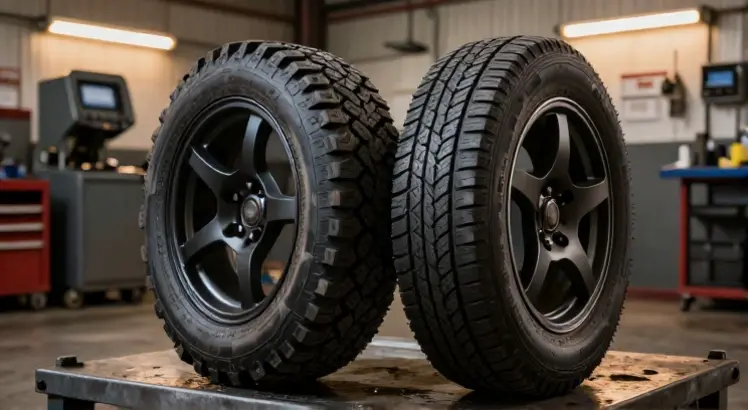
You rely on your truck to haul heavy loads, navigate muddy job sites, or power through a sudden mountain snow squall. The tires you pick define how your vehicle behaves when the pavement disappears. Among the sea of aggressive tread patterns and reinforced sidewalls, the debate often narrows down to two legendary names, Cooper and Goodyear. Choosing between Cooper vs Goodyear tires is not simply about picking a brand, it is about matching a tire’s DNA to your driving reality.
We have put thousands of miles on both brands to understand where each one shines. While Goodyear often brings the high-tech, premium engineering, Cooper answers with extreme value and toughness that often surprises drivers with a higher price tag in mind. This guide will strip away the marketing fluff. We will dig into the rubber compound science, the whisper-quiet highway manners, the claw-like off-road grip, and the financial sting of replacing a full set.
We will analyze treadwear warranties, compare handling in wet and snowy conditions, and break down the manufacturing origins that influence quality. Understanding these differences will prevent you from wasting money on a tire that does not fit your truck’s attitude.
Brand Legacy and Manufacturing Heritage

Cooper Cobra Radial G/T All-Season P235/60R15 98T Tire
Check PriceA tire’s birthplace and company philosophy tell you a lot about its engineering priorities. Cooper Tires, founded in 1914, built its reputation on the philosophy of value without sacrifice. The company, now a subsidiary of Goodyear following a 2021 acquisition, historically positioned itself as the champion of the working class. Cooper focused heavily on direct replacement tires that often outperformed the original equipment without costing a fortune. Their production footprint is heavily concentrated in the United States, with major plants in Ohio, Arkansas, and Mississippi.
Goodyear, on the other hand, is the goliath of the industry, established in 1898. The brand built a legacy through racing dominance and aerospace innovation. Goodyear tires have literally rolled on the moon. Their identity is tied to pioneering firsts, like the first tubeless tire. The company operates globally with significant R&D centers dedicated to polymer science aimed at reducing rolling resistance and increasing high-speed durability.
Interestingly, because Goodyear now owns Cooper, there is a cross-pollination of technology happening behind the scenes. However, the brands remain distinct in their market placement. Cooper maintains a rugged, straightforward American manufacturing identity, while Goodyear pushes a global, high-performance image visible in NASCAR and European racing circuits.
On-Road Performance and Highway Comfort

GOODYEAR EAGLE TOURING – 285/45R22 114H XL VSB
Check PriceFor the majority of truck owners, highway stability and daily driving refinement matter more than rock crawling. This is where the contrast between these two brands becomes crystal clear. Goodyear invests heavily in computer-modeled tread patterns that actively fight road noise. Their ComfortBalance Technology channels sound waves into specific grooves to cancel out hum, resulting in a near-silent cabin experience.
Cooper takes a slightly different approach to ride comfort. While modern Cooper touring tires are remarkably quiet, they achieve this through variable pitch sequencing that prioritizes tread life over absolute silence. You might hear a faint, low-frequency rumble on coarse asphalt with a Cooper tire where a comparable premium Goodyear track might remain silent. Nevertheless, for a heavy-duty truck, many drivers find the slightly firmer sidewall stiffness of a Cooper tire translates to a more planted, connected steering feel when towing.
Steering Response and Cornering Grip
Goodyear tires generally feature a softer tread compound that heats up quickly, offering immediate bite during emergency lane changes. This makes models like the Goodyear Wrangler series feel car-like and sporty, despite being mounted on a heavy truck. The steering response is typically crisp on center, removing that floating sensation lifted trucks sometimes suffer from.
Cooper tires, especially their Discoverer series, trade a tiny bit of that razor-sharp turn-in for a heavier-duty feel. The increased tread block rigidity usually results in slightly less lateral squirm under heavy braking. For a driver who frequently navigates roundabouts or tightening highway ramps with a trailer in tow, the Goodyear often feels more progressive, while the Cooper feels industrially solid.
Off-Road Dominance and All-Terrain Ability

Cooper Endeavor Plus All-Season 205/70R16 97H Tire
Check PriceThis is the battleground where many purchase decisions are made. If you find yourself on gravel forest service roads or deep sand dunes, you need a tire that evacuates debris and resists punctures. Goodyear brings proprietary technologies like Durawall, which offers a thicker layer of rubber on the sidewall to resist cuts. The Wrangler All-Terrain Adventure is a marvel of engineering that utilizes Kevlar, a material usually reserved for bulletproof vests, to reinforce the tread.
Cooper answers back with a philosophy of brute simplicity. The Cooper Discoverer STT Pro is a mud-terrain fan favorite because of its Armor Tek3 carcass construction. Instead of relying on exotic space-age materials, Cooper doubles down on physical thickness and tread depth. The result is a tire that feels slightly heavier but is incredibly resistant to stone drilling. Off-road enthusiasts often debate whether the Goodyear Wrangler Duratrac or the Cooper Discoverer S/T Maxx clears mud faster.
- Goodyear Wrangler Duratrac: Features TractiveGroove Technology, offering excellent snow traction but a slightly more vulnerable sidewall in sharp rock beds.
- Cooper Discoverer Rugged Trek: Provides dual-sidewall designs (you can pick the look), with aggressive scalloped shoulder lugs that bite deeply into loose terrain without tearing.
- Snow and Ice Performance: The Goodyear rubber formulation tends to remain slightly softer in freezing temperatures, providing a technical edge on black ice without needing immediate weight over the axle.
In deeply muddy conditions, many off-road purists prefer the Cooper compound’s resistance to mud packing. The spaced-out tread blocks act more like conveyor belts of dirt, digging down to a hard floor. The Goodyear is often the better choice if your off-roading involves a lot of slick rock surfaces where a sticky compound matters more than clearance.
Wet Weather Safety and Hydroplaning Resistance

Goodyear Eagle F1 All Season 275/30ZR20 97Y All- Season Tire
Check PricePickup trucks are notoriously light over the rear axle, making wet traction a constant safety concern. When comparing Cooper vs Goodyear tires in the rain, the difference lies in the groove geometry. Goodyear allocates a significant amount of void space for water evacuation. Their Aquachannel designs essentially cut through standing water like a wedge. This leads to higher hydroplaning speed thresholds.
Cooper focuses on silica-enhanced tread compounds for their wet grip. Silica is a derivative of sand that prevents the rubber from becoming glassy when cold and wet. You still find effective sweeping lateral grooves in the Discoverer series, but Cooper often relies more on the chemical mixture of the tread, rather than just the tread design, to find traction. In a sudden summer downpour, you might find a Goodyear tire recovers from a slide slightly faster. However, a Cooper highway tire offers a very progressive loss of grip, meaning it communicates the limit to the driver loudly before breaking loose.
Durability and Treadwear Mileage Guarantee
Longevity is the invisible price tag. If you spend a premium on a tire but replace it twice as fast, the initial cost is irrelevant. Goodyear offers some industry-leading treadwear warranties, particularly on their highway tires. The Goodyear Wrangler Steadfast HT has pushed the boundaries of life expectancy with guarantees rivaling specialized long-haul truck tires.
Cooper excels in durability, not always in the pure mileage number, but in resistance to premature failure. The manufacturers explicitly design the sidewalls to withstand severe curb strikes and overloading. A common observation among reviewers is that Cooper tires wear like iron, exhibiting less chunking or chipping on gravel roads. Buyers of the best wheel spacers often pair them with aggressive Cooper tires because the robust inner carcass handles the altered steering geometry stress without producing uneven wear patterns as quickly.
Historically, Goodyear’s softer compound could lead to rapid shoulder wear if tire rotations were delayed. However, recent EV-ready and hard-wearing Goodyear models are closing this gap rapidly. Today, both brands deliver competitive service life, but Cooper holds the crown for resisting abuse on construction sites.
Price Analysis and Overall Value
No one buys tires without glancing at the total invoice. As a general rule, Goodyear commands a premium. That extra cash goes toward innovative marketing, motorsport sponsorship, and advanced noise-canceling technologies. A full set of flagship Goodyear Wrangler AT tires can cost several hundred dollars more than the Cooper equivalent.
Cooper has historically undercut this price point while delivering 95% of the real-world performance. This created a cult following among fleet managers and contractors. The value proposition of Cooper lies in its philosophy of providing top-tier construction without the cutting-edge aesthetic trimmings. When it comes to upgrading truck stance and stability, the tire budget is crucial, and saving money on rubber might free up budget for essential suspension corrections. The initial price gap often sways budget-conscious buyers who still demand a tire that can survive hot pavement and jagged quarry rock.
Warranty and Customer Support
Goodyear’s distribution network is massive. You can find a dedicated Goodyear store in most cities with standardized service. Their customer satisfaction policy is generally more forgiving on treadwear claims, provided you have rotation documentation.
Cooper’s warranty process feels different. It is traditionally handled through independent dealerships, like the iconic Tire Dealer Near Me shops. While the warranty mileage is often competitive, the brand loyalty of Cooper buyers often means they stick with a specific trusted mechanic who stocks them. Cooper tires often are a favorite on comparison lists like Cooper tires vs Michelin, where they win the value battle against the most expensive segments.
The key takeaway in the price fight is this, Goodyear charges for elite refinement, while Cooper charges for rugged reliability. It is a luxury tool versus a utilitarian powerhouse.
Frequently Asked Questions
Did Goodyear buy out Cooper Tires?
Yes, the acquisition was finalized in 2021. Goodyear purchased Cooper in a deal valued at approximately $2.8 billion. This merger combined Goodyear’s strength in premium original equipment with Cooper’s stronghold in the light truck and SUV replacement markets. Despite the ownership, the companies continue to market their tires as separate brands with distinct engineering teams and product roadmaps.
Is Cooper a cheaper version of Goodyear?
Not exactly. While generally less expensive, Cooper is not simply a detuned Goodyear. Cooper operates with a different design philosophy. It often prioritizes heavy-duty carcass strength and all-terrain ruggedness over the silent-rolling refinement that Goodyear prioritizes. Many off-roaders believe high-end Cooper mud tires outperform comparable Goodyear models in deep, sharp rock environments.
Which tire is quieter, Goodyear or Cooper?
Goodyear is generally the winner in noise, vibration, and harshness (NVH) suppression. Goodyear uses advanced sound frequency modeling to cancel out specific hum tones. Cooper tires, while much better than budget imports, can produce a subtle hum on textured concrete highways. However, aggressive all-terrain models from both brands will inevitably make some noise.
Are Cooper tires good enough for towing heavy loads?
Absolutely. This is where Cooper often excels. The Discoverer AT3 series is a favorite among travel trailer owners because of its high-load range options and sturdy internal architecture. The increased ply rating gives drivers a stable, sway-resistant experience. Goodyear’s Endurance line also offers robust towing performance, but Cooper has a legendary reputation within the boating and RV community for durability.
The Final Verdict and Actionable Selection Guide
Making the final call between Cooper and Goodyear tires depends entirely on your truck’s daily workload. The differences are nuanced but consequential. Goodyear delivers a refined, technically advanced ride. It is the tire for the driver who wants to forget the rubber is there, to enjoy a quiet commute before a heavy weekend haul, and who wants the security of a massive nationwide warranty network.
Cooper is the blue-collar hero. It is the tire for the owner who sees scuffs in the clear coat as a badge of honor. It provides indestructible sidewalls and a compound that laughs at sharp gravel. It costs less, lasts fiercely, and performs with a predictable, honest attitude.
If your truck is a pavement princess that occasionally sees a dirt parking lot, choose the Goodyear for its comfort. If your truck earns its keep on a ranch or a muddy jobsite while sticking to a budget, buy the Cooper. You will not regret the savings, and you will appreciate the resilience. To maximize the footprint of your new set, ensure you are using a hub-centric fitment, something we cover when discussing tire sizing and fitment safety standards.
Evaluate your most frequent driving environment. Identify the primary surface, asphalt, gravel, or mud. Then, apply the one-third rule. Spend one-third of your budget on the tires and reserve funds for an immediate alignment and a quality set of high-quality wheel spacers if your offset needs adjustment. Your truck is only as reliable as the four patches of rubber touching the ground. Choose wisely, rotate frequently, and keep the pressure dialed.