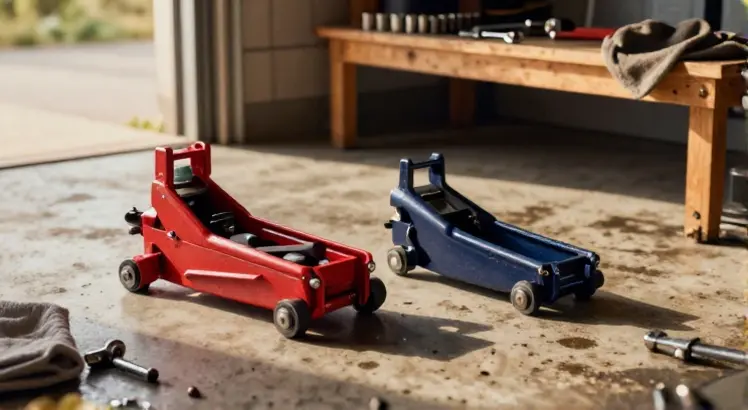
Bottle jack vs scissor jack is one of the first dilemmas you face when assembling a roadside emergency kit. If you have ever been stranded on the side of the road with a flat tire, you know that the factory-provided tool can feel flimsy and slow. Many drivers immediately look for an upgrade to make the tire-changing process safer and less tedious.
However, choosing the wrong type of jack can damage your vehicle or, worse, lead to a dangerous collapse. The debate is not just about raw power, it is about portability, clearance, and stability. Understanding these two tools is the key to never fearing a flat tire again.
What is a Bottle Jack?

YELLOW JACKET 4 Ton Muti-Directional Welded Bottle Jack with Carrying Case
Check PriceA bottle jack is a compact, hydraulic lifting device shaped like a bottle. It uses a vertical piston that extends upward to push against the vehicle’s frame. Because it relies on hydraulic fluid and a cylinder, it can generate massive lifting force with very little physical effort from the user.
You typically find these jacks in the garages of truck owners and off-road enthusiasts. Unlike a standard scissor mechanism, a bottle jack is rated for high weight capacities, often ranging from 2 tons to upwards of 20 tons. The hydraulic mechanism provides a smooth lift, and if maintained properly, these tools can last for decades.
However, size is the trade-off for this power. Even small-capacity bottle jacks have a taller collapsed height than scissor jacks. If you drive a car with low ground clearance, slipping a tall bottle jack under the pinch weld might be impossible without first driving the car onto a block.
Key Advantages of a Bottle Jack

BIG RED 20 Ton (40,000 LBs) Torin Welded Hydraulic Car Bottle Jack
Check Price- Immense Lifting Capacity: They easily handle heavy SUVs, trucks, and trailers without the operator breaking a sweat.
- Minimal Physical Strain: The hydraulic pump does the work. A few strokes of the handle can send a heavy vehicle skyward.
- Durability: Solid steel construction means there are fewer plastic parts to fail.
The Downside of Hydraulic Power
Bottle jacks are generally heavier to carry, which slightly impacts fuel economy if you treat your trunk like a tool shed. They also require periodic maintenance. You must check the hydraulic fluid levels and ensure the seals are not leaking. Another specific limitation is the orientation, as most bottle jacks cannot be used on their side, you must keep them vertical for the pump to work correctly.
What is a Scissor Jack?
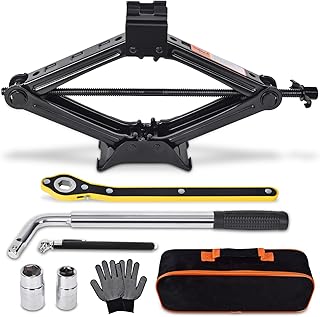
Scissor Car Jack 2 Ton (4409 lbs) Tire Changing Kit with Lug Wrench
Check PriceA scissor jack is a mechanical device that uses a screw mechanism to pull two metal arms together, creating an upward diamond shape, hence the name scissor. This is the standard tool that comes with 90% of sedans and crossover SUVs from the factory.
Its primary appeal is its compact footprint. When folded flat, a scissor jack occupies almost no space. It tucks neatly into a spare tire well or a side compartment in your trunk. It relies on mechanical advantage, so as long as the threads are not stripped, it is a reliable, zero-maintenance tool.
The operation involves a crank handle. You rotate the handle, and the screw thread slowly converts rotational energy into lifting force. This process is inherently slower than hydraulics. Because of the high friction, you will often sweat through a shirt in the summer heat while cranking these jacks, especially on heavier vehicles.
Key Advantages of a Scissor Jack
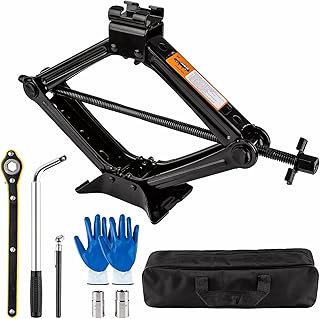
Beaiguna Portable Car Jack Kit, 2 Ton (4409 lbs) Scissor Jack for Car
Check Price- Ultra-Low Profile: They fit under low-clearance sports cars and sedans that have a flat tire, which reduces clearance further.
- Lightweight Design: They are usually cast or stamped steel, keeping the car’s overall weight down.
- No Fluid Leaks: Since they are purely mechanical, you can store them in any position without worrying about oil spills.
Limitations of the Standard Crank
Stability is the biggest issue with scissor jacks. They have very small bases that can sink into soft asphalt or gravel, causing the vehicle to tilt dangerously. Also, they are built for specific pinch welds, and if the jack slips off that point, the vehicle can drop instantly. Lateral force is their enemy.
Bottle Jack vs Scissor Jack: The Detailed Comparison

VEVOR Hydraulic Bottle Jack, 20 Ton/44092 LBS All Welded Bottle Jack
Check PriceTo truly understand the bottle jack vs scissor jack rivalry, you must look beyond the surface. These tools approach the same task of lifting a multi-ton machine with wildly different engineering philosophies. Your choice will directly affect how quickly and safely you get back on the road.
1. Lifting Mechanism and Speed
The hydraulic mechanism of a bottle jack is significantly faster during the initial lift. You insert the handle, pump, and watch the vehicle rise steadily. In contrast, the scissor jack requires constant, tedious rotation. If a storm is rolling in, speed actually becomes a safety feature, and the bottle jack wins this round hands down.
2. Stability and Footprint
Here, we have a technical tie depending on the model, but budget scissor jacks usually lose. A standard scissor jack has a footprint the size of a wallet. On hard, level concrete, this is fine. On the shoulder of a dirt road, it is a disaster. A bottle jack possesses a wider, heavier base, making it much less prone to tipping over during tire changes.
However, you must pair a bottle jack with a jack stand. No matter which tool you use, never crawl under a vehicle supported only by a jack. If you are working on a lifted truck, please visit our guide on how to jack up a truck safely.
3. Vehicle Compatibility and Clearance
This is where the scissor jack shines. When a tire deflates, the car’s frame lowers several inches. A bottle jack might simply not fit under the frame rail. You could need to carry a separate block of wood to drive the flat tire onto to gain clearance. A scissor jack often slides right into place with millimeters to spare.
For heavy-duty contexts, however, the scissor jack is often useless. A sedan kit cannot lift a fully loaded Suburban. Using an overloaded jack is a critical safety hazard. You need the hydraulic advantage of a bottle jack for anything rated above a half-ton payload.
4. Storage and Portability
If you drive a small hatchback where every inch of trunk space counts, the scissor jack is a miracle of engineering. Bottle jacks are dense, heavy chunks of steel. They can become projectiles in a rollover accident if not properly secured. The lightweight scissor jack fits under the carpet and is forgotten until you have a flat.
5. Durability and Maintenance
Scissor jacks suffer from stripped threads if you over-crank them. Once the threads are crossed or the gears grind down, the jack is a paperweight. Bottle jacks fail silently when the internal seals dry out or crack. You might pump the handle and feel zero resistance, or the jack will slowly creep down under load. Storing a bottle jack upright is critical to prevent oil leaks.
Safety Protocols You Must Not Ignore

BIG RED T10152 Torin Steel Scissor Lift Jack Car Kit, 1.5 Ton (3,000 lb) Capacity
Check PriceRegardless of which side you choose in the bottle jack vs scissor jack debate, physics is not negotiable. A jack is a lifting device, it is not a holding device. The single most dangerous mistake motorists make is removing a tire without a backup safety system in place.
Always chock the opposite wheels. Engage the parking brake. Place the jack exactly on the vehicle’s designated lift point. If the vehicle wobbles even slightly, lower it back down and reposition. When using a bottle jack, make sure the ground underneath is compacted and level because the force concentrates in a small area, which can cause pavement to crack on a hot day.
How to Choose the Right Jack for Your Garage
The choice comes down to your primary use case. Do not think of these tools as interchangeable under all circumstances. Instead, match the tool to the job and the vehicle. The wrong choice will leave you stranded or facing a dangerous mechanical failure.
Choose a Bottle Jack If:

BIG RED T91203B Torin Hydraulic Welded Bottle Jack, 12 Ton (24,000 lb) Capacity
Check Price- You drive a body-on-frame truck or a large SUV.
- You value lifting speed and minimal physical strain.
- You frequently tow trailers and need to change trailer tires.
- You understand hydraulic maintenance and check seals regularly.
Choose a Scissor Jack If:

Scissor Jack 3 Ton, 4.1″-18.3″ Lifting Car Jack, Heavy Duty Car Jack Kit
Check Price- You drive a low-clearance sedan or a small coupe.
- You need to save weight and space in a compact trunk.
- You want a maintenance-free emergency tool.
- You only lift the vehicle during rare roadside emergencies.
The Hybrid Solution for Professionals
Many experienced home mechanics buy both tools. They keep a high-quality, wide-base scissor jack in the daily driver for urban commuting. In the truck bed, they store a rugged, high-lift bottle jack alongside a square of pressure-treated lumber. If you want the ultimate upgrade, consider an electric car jack for home use. For an in-depth look at these premium options, read our detailed article on the best electric car jack for effortless lifting.
This approach represents a best-of-both-worlds strategy. You keep the lightweight portability of the scissor jack for rear-wheel punctures on the shoulder of the highway. You use the bottle jack for rotating tires at home or handling a double-axle situation where multiple lifts are required.
Frequently Asked Questions
Can I use a bottle jack to change a car tire on a sedan?
You can, but you must measure the collapsed height against your car’s clearance. Most sedans sit too low, especially with a flat tire. If the bottle jack fits, it provides a safer and more stable lift than the factory scissor jack.
Why do car manufacturers still include scissor jacks?
Cost, weight, and packaging are the main reasons. Scissor jacks are incredibly cheap to mass-produce. They also weigh significantly less, helping automakers meet fuel economy standards without sacrificing trunk space like a hydraulic unit would.
Are bottle jacks dangerous on uneven ground?
Yes. Because they concentrate force on a small base, they can punch into soft asphalt or tip over on gravel. Always use a solid platform, like a thick plywood board, under a bottle jack on anything less than perfect concrete.
Do I need to lubricate a scissor jack?
Absolutely. Although maintenance-free in terms of fluid, a scissor jack’s threads require occasional greasing. Spray white lithium grease on the central screw mechanism at least once a year to prevent rust and stripping.
How do I position a scissor jack correctly?
Look for the vehicle’s pinch weld. Most cars have a reinforced notch or a cutout in the plastic rocker panel specifically for the jack’s head slot. Check out our full guide on how to use a scissor jack safely for a step-by-step visual breakdown.
Final Verdict on the Jack Selection

VEVOR Hydraulic Bottle Jack, 20 Ton/44092 lbs Low Profile Welded Bottle Jack
Check PriceThe battle of bottle jack vs scissor jack does not have a single universal winner. If you drive a heavy vehicle or tow frequently, owning a high-quality bottle jack is a non-negotiable upgrade for both safety and convenience. If you drive a small city car, a premium aftermarket scissor or compact jack is the practical choice.
Never rely solely on the flimsy OEM unit without inspecting it first. Whichever you choose, pair it with a solid lug wrench and a reflective safety triangle. According to the National Highway Traffic Safety Administration, ensuring your equipment is rated for the axle load is the most critical step in preventing roadside accidents (source). Prioritize weight capacity over price, and your jack will serve you safely for years.