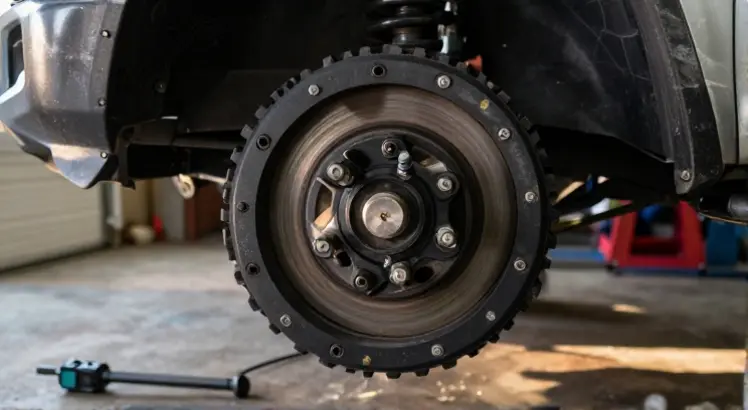
If you drive a truck, you have probably heard a buddy at the job site say, Throw some spacers on it, it will look mean. But before you bolt a set of steel plates behind your wheels, you need a real answer to the question: are wheel spacers safe on trucks? The truth is, a quality set of spacers, installed correctly, can be perfectly safe. However, cutting corners on materials or skipping critical steps like using a torque wrench often leads to catastrophic failure. This guide breaks down the engineering, the risks, and the proper techniques so you can make an informed decision.
What Exactly Are Wheel Spacers?

KSP 6X5.5 Wheel Spacers for Silverado Sierra
Check PriceWheel spacers are precision-machined discs that slide over your truck’s wheel studs and sit between the hub and the wheel. Their primary job is to push the wheel outward, widening the vehicle’s stance. Truck owners install them to achieve a more aggressive look, to clear larger aftermarket tires, or to prevent the inner sidewall from rubbing against suspension components when running wider rubber.
These components come in two distinct flavors. A simple flat spacer relies on your existing wheel studs to hold everything together. The more advanced, and significantly safer, option is a bolt-on adapter. This design uses separate hardware to attach the spacer to the hub, and then the wheel bolts to the spacer. Understanding this difference is the first step toward understanding safety.
How Wheel Spacers Affect Truck Safety

KSP 2 inch 6×139.7mm Wheel Spacer
Check PriceWhen you add a spacer, you change the suspension geometry. You move the wheel away from the hub, which shifts the load further out on the axle. This added distance acts as a lever, increasing the stress on the wheel bearings, ball joints, and ball joint seats. The truck’s factory engineers designed those components to handle a specific load at a specific distance, so deviating from that spec will accelerate wear, but it does not usually cause immediate failure if the spacer is thin.
The biggest safety variable is the shear force on the lug studs. A flat spacer that is too thick will leave you with dangerously short thread engagement. If you don’t catch this, the lug nuts can strip and rip out under throttle or hard braking. That is why industry experts agree that any flat spacer longer than a quarter of an inch on a heavy truck requires replacing the stock studs with extended, high-tensile strength alternatives.
The Importance of Hub-Centric vs. Lug-Centric Spacers
If you want the safest setup, you must run a hub-centric spacer. A hub-centric spacer has a machined lip that fits snugly over the vehicle’s hub flange. This lip bears the weight of the truck and absorbs road impacts. A lug-centric spacer has no lip, which forces the wheel studs to carry the entire vertical load. On a heavy vehicle, that is a recipe for snapped studs and vibration.
For your truck, you should never accept a loose fit. If you order a spacer and it doesn’t sit dead flush against the hub with zero play, do not install it. The spacer must be matched to your specific hub bore size, not a generic universal fit. We have covered this in our detailed look at hub-centric wheel spacers and why they matter. This single choice often separates a reliable daily driver from a highway hazard.
Key Safety Factors: Materials, Installation, and Torque

KSP 6×135 Hubcentric Wheel Spacers for F150
Check PriceSafety on a truck is not about luck, it is about metallurgy and process. You cannot treat spacers like a simple accessory. They become an integral part of your drivetrain the moment you accelerate. The raw material must be forged or billet 6061-T6 aluminum, or high-grade steel. Cast aluminum is too brittle and fractures under the cyclical loading a truck frame produces off-road.
Choosing a High-Quality Material
Always look for spacers machined from a single block of T6 aluminum. This material offers the perfect balance of strength and weight while resisting corrosion from road salt. Steel spacers are incredibly strong but add significant unsprung weight, which can make the suspension feel sluggish. You should avoid cheap cast units imported from overseas factories with no quality control traceability.
Many professional mechanics trust brands like BORA and Spidertrax because they machine their adapters in-house and laser engrave load ratings directly on the part. In fact, if you are researching specific brands, you can read our comprehensive analysis of Bora wheel spacer safety to understand what top-tier engineering looks like.
The Non-Negotiable Rule of Torque
Installation failure is the leading cause of wheel spacers coming loose. You can own the most expensive billet spacers on the market, but if you blast them on with an air impact wrench and no torque wrench, they will fail. Aluminum expands and contracts at a different rate than the steel hub. You must use a calibrated torque wrench and follow a strict star-pattern sequence.
Good practice requires a two-stage torque process. First, seat the hardware to a moderate clip using hand tools, then finish with the final specified torque value. Most half-ton trucks require the spacer nuts to be torqued between 90 and 140 foot-pounds, but you must verify the spec from the spacer manufacturer, not just the truck manual. After driving 50 miles, you must remove the wheels and re-torque every single fastener. Skipping this re-torque step is dangerous.
Common Risks and How to Mitigate Them

KSP 6X139.7 Silverado Hubcentric Spacer
Check PriceEvery modification has trade-offs, and understanding them is what makes a responsible truck owner. The first risk is accelerated wear on the wheel bearings. When you push the tire out by two inches, the bearing pivots on a longer lever arm. This does not mean your wheel is about to fall off, but it might mean replacing a hub assembly at 80,000 miles instead of 120,000 miles.
Another risk is fender contact. A wider stance combined with heavy payload towing can cause the tire sidewall to slam into the metal fender lip during suspension compression. You must check for full lock-to-lock clearance on a forklift or a ramp, not just on flat ground. Here is a quick checklist to keep your truck safe:
- Measure thread engagement with a caliper, you need a minimum of 6.5 full turns.
- Clean the hub face completely with a wire brush to remove rust and ensure a flush mount.
- Apply a small dab of blue thread locker on internal adapter bolts only, never on the main vehicle studs.
- Perform a re-torque session after exactly 50 miles of driving.
Vibration is another red flag. If your steering wheel shakes immediately after a spacer install, stop driving. The spacer is likely not perfectly hub-centric, or a mounting surface is contaminated. A high-quality spacer will not introduce vibration if it is machined to a tolerance of 0.001 inches or less.
Legal and Warranty Considerations

KSP 6X5.5 Wheel Spacers for Tacoma 4Runner
Check PriceSafety is not just about what holds your truck together today, it is about compliance and liability. In many jurisdictions, having tires that poke out past the stock fenders without extended flares is illegal. Spacers often push the tires out to a point where they throw rocks into windshields of the cars behind you. You may need to add mud flaps or wide fenders to stay street legal.
Furthermore, a dealership cannot void your entire warranty simply because you installed spacers. However, under the Magnuson-Moss Warranty Act, if your wheel bearing fails, the dealership can deny that specific repair if they prove the spacers caused the failure. It is wise to keep your stock rims and remove the spacers before going in for major suspension warranty work.
Real-World Safety Tips for Truck Owners
If you decide that the aesthetic or clearance benefits are worth it, you should buy a kit that is application-specific. A generic one-size-fits-all kit does not belong on a heavy-duty pickup. You need a kit designed for your exact year, make, and bolt pattern. For a list of solid options, you can check our guide to the best wheel spacers for trucks to see which units are built for heavy payloads.
When you pair your spacers with oversized tires, the forces multiply. A 35-inch tire already puts significant stress on the front end, and adding a two-inch spacer pushes that stress dramatically. You should budget for a set of upgraded upper control arms and heavy-duty tie rod ends if you are running this setup. Overlooking these supporting modifications is a preliminary reason people blame spacers for failures that are actually caused by a worn front end.
Also, never use anti-seize compound on the threads. Anti-seize acts as a lubricant, which causes you to over-torque the bolt and elongate the threads without hitting the correct clamping force. The threads must be clean and dry, or treated with a mild thread locker as specified. This is a nuanced detail that separates backyard mechanics from certified shops, a concept echoed by Tire Rack’s technical overview of wheel spacer design.
Frequently Asked Questions

dynofit 2in 6×5.5 Wheel Spacers
Check PriceDo wheel spacers cause truck axles to snap?
No, high-quality spacers do not directly cause axles to snap under normal use. The axle shaft is designed to handle torsional twisting, not bending load. The bending load is absorbed by the hub and bearings. However, if you install an aggressive offset spacer on a full-floating rear axle and constantly tow maximum loads, you may exceed the manufacturer’s safety margin. Stick to spacers within 1.5 inches on a daily driver to avoid excess leverage.
Are wheel spacers safe for off-roading?
They can be, but you must use a bolt-on style with hardened 12.9-grade studs. Rock crawling puts immense side loads on the spacer. A flat slip-on spacer is unacceptable for off-road use because it relies only on the stock studs. Always carry a torque wrench in the truck and check the spacer bolts before airing down and hitting the trail. Vibration from washboard roads can occasionally back off improperly torqued bolts.
Can I stack two wheel spacers for more width?
Absolutely not. Stacking wheel spacers is extremely dangerous and is widely condemned by all professional automotive engineers. When you double up, you introduce a second shear plane and multiple contact points that can shift under load. This creates an unpredictable wobble and overloads the studs far beyond their tensile strength capacity. If you need more width, you must buy a single, custom-machined spacer of the correct thickness.
How thick is too thick for a truck wheel spacer?
For a flat slip-on spacer, anything beyond 0.5 inches is generally too thick without extended studs. For a bolt-on adapter, a thickness of 2.0 inches is widely accepted as a safe maximum for heavy trucks. Beyond that, even high-quality adapters create a lever arm that significantly shortens the lifecycle of the hub assembly and can make low-speed steering heavy and unresponsive. Always aim for the smallest spacer that achieves your necessary clearance.
Conclusion
So, are wheel spacers safe on trucks? The answer is a confident yes, but only if you make the right choices. Safety lives in the details: hub-centric designs, billet aluminum construction, precise torque values, and strict re-torque intervals. Cutting costs on a generic set or ignoring proper installation procedures introduces risks that no truck owner should accept. The spacer itself is just a piece of metal, the real safety protocol is the discipline you bring to your driveway. Choose a premium brand, install it with care, and enjoy a stance that is as secure as it is sharp.