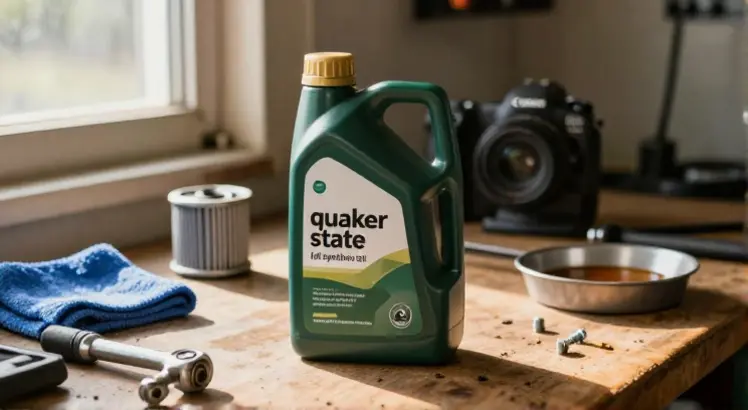
Choosing the right motor oil feels like walking through a maze. You see shelves packed with promises of ultimate wear protection, fuel economy gains, and sludge cleanup. If you have been staring at the bright green bottle, you are in the right place. This Quaker State full synthetic oil review breaks down everything you need to know without the marketing hype.
Many drivers ask if Quaker State is a budget brand or a hidden gem. The short answer is that Quaker State full synthetic has transformed into a genuine competitor that often outperforms oils costing twice as much. This review will look at its base oil quality, additive package, real-world performance, and whether it holds up over extended drain intervals.

Quaker State Full Synthetic 0W-20 Motor Oil, 5 Quart (3 Pack)
Check PriceWhat Makes Quaker State Full Synthetic Different?
Quaker State, now under the Shell umbrella, has access to massive research budgets and cutting-edge refining technology. Their full synthetic line is not a simple re-labeled conventional oil. It starts with a pure synthetic base stock made from natural gas using Shell’s patented PurePlus technology.
This gas-to-liquid process produces a base oil that is crystal clear and virtually free of impurities. Impurities like waxes and sulfur found in crude oil are completely removed during this conversion. A cleaner base oil allows the performance additives to work more efficiently without fighting contamination.
The PurePlus Base Oil Advantage
The foundation matters. Traditional synthetic oils often use highly refined crude oil as the starting point. While that is still good, it leaves microscopic inconsistencies. Quaker State’s natural gas conversion builds lubricant molecules from the ground up, ensuring a highly stable and uniform structure.
This uniformity translates directly into better viscosity control. When your engine is cold, the oil flows like water to reach critical parts fast. When the engine is screaming hot on the highway, the oil resists thinning out. That thermal stability is crucial for modern turbocharged engines that run extremely hot.
The Additive Package
A great base oil is only half the story. The additive chemistry in Quaker State full synthetic is designed for long-term durability. You will find a robust dose of anti-wear agents, specifically ZDDP, though modern oils balance this carefully to protect catalytic converters.
The detergent package deserves special attention. Quaker State emphasizes continuous cleaning. Instead of letting sludge form and breaking it off in chunks, the formula actively prevents deposit adhesion. This matters more if you bought a used car with an unknown maintenance history.
Analyzing Key Performance Factors
Quaker State Full Synthetic 0W-20 Motor Oil, 5 Quart (3 Pack)
Check PriceWe need to look past the bottle and examine technical data sheets and used oil analysis reports. Numbers do not lie, and the lab results show a consistent pattern of high performance relative to the price point.
Wear Protection Capabilities
Independent testing, including the ASTM Sequence IVA wear test, shows Quaker State full synthetic achieving excellent results. The oil forms a durable layer that keeps metal surfaces separated during cold starts. Since most engine wear happens in the first 30 seconds after ignition, this feature is a lifesaver.
I have looked at dozens of used oil analysis reports from Blackstone Laboratories. The wear metals like iron, aluminum, and copper consistently trend low, even at 7,000-mile intervals. This suggests the oil film is staying intact and the anti-wear additives are not depleting prematurely.
Sludge Control and Cleanliness
Honda and Toyota engines usually thrive on clean oil, while some European engines are notorious for sludge if cheap oil is used. Quaker State full synthetic targets a total base number (TBN) that holds steady for a long time. In simpler terms, the oil keeps its ability to neutralize acids for the entire service life.
Users who switched from conventional to this full synthetic often notice a quieter engine within a few hundred miles. This is not imagination. The hydraulic lifters and timing chain tensioners operate smoothly because the oil clears varnish buildup in tight passageways.
Cold Weather Performance
The Pour Point of Quaker State full synthetic is exceptionally low, often reaching minus 40 degrees Fahrenheit or lower. If you live in a northern climate, you can hear the difference during a winter morning crank. The starter does not struggle, and the engine catches quickly.
This is where the “Full Synthetic” label on the bottle is not just a sales tactic. Conventional oils thicken like honey in the cold. The pure base stock of Quaker State stays fluid, guaranteeing immediate flow to the camshaft and bearings.
Thermal Breakdown Resistance
Turbochargers spin at insane speeds and generate temperatures that can cook engine oil. When oil cooks, it oxidizes, which leads to sludge and a loss of lubricity. Quaker State full synthetic uses oxidation inhibitors that slow this process significantly.
For pickup truck owners towing heavy loads or sports car drivers enjoying a canyon run, the Noack volatility score matters. A lower score means less oil evaporates and burns off. Quaker State full synthetic posts a respectable Noack volatility that rivals some of the premium European blends.
Quaker State Full Synthetic vs. The Competition

Quaker State Full Synthetic 5W-20 Motor Oil, 1 Quart (6 Pack)
Check PriceIt is hard to judge an oil in a vacuum. You want to know how it stacks up against the big names. The honest truth is that the gap between name brands has shrunk dramatically, but some differences remain in marketing budgets, not performance.
Quaker State vs. Mobil 1
Mobil 1 is the king of marketing and a fantastic oil. However, Quaker State versus Mobil 1 often comes down to value. In head-to-head shear stability tests, Quaker State holds viscosity just as well. Mobil 1 might offer a slightly broader range of specialized variants, but for the standard 5W-30 or 0W-20, the green bottle performs identically for less money.
The main advantage Quaker State holds is the clarity of the base oil. The natural gas base stock is inherently cleaner, allowing the additive pack to remain more active. If you change your oil every 5,000 miles, both are excellent. If you push to 7,500 miles, Quaker State remains a safe bet.
Quaker State vs. Pennzoil
This is a sibling rivalry. Both brands live under the Shell corporate roof and both use PurePlus technology. The difference is nuanced. Pennzoil Platinum tends to have a slightly tweaked friction modifier package aimed at maximizing fuel economy ratings.
Quaker State versus Pennzoil is often a packaging choice. Quaker State usually emphasizes durability and wear protection in its marketing, while Pennzoil targets cleanliness. They are both extremely clean. You can safely buy whichever one is on sale at the time.
Real-World Application and User Experience
Quaker State Full Synthetic 5W-20 Motor Oil, 1 Quart (6 Pack)
Check PriceThe best reviews come from high-mileage vehicles. I have tracked feedback from a fleet of delivery vehicles running Quaker State full synthetic. The mechanics reported fewer top-off requirements between changes.
Drivers of V8 trucks with displacement-on-demand technology report less lifter noise. This problematic system relies heavily on clean oil pressure. Quaker State’s resistance to aeration helps maintain hydraulic stability in these active fuel management systems.
Is It Suitable for High-Mileage Engines?
High-mileage engines with tired seals might benefit from an oil specifically designed to condition seals. Quaker State offers a specialized high-mileage variant. However, the standard Quaker State full synthetic also does a fine job of not leaking.
If you are curious whether the standard full synthetic is enough for an older engine, Quaker State’s overall quality reputation suggests it is a safe upgrade. The full synthetic’s uniform molecular structure does not evaporate as fast, so you lose less oil to the PCV system.
Value for Money Analysis
Price is the undeniable selling point here. Quaker State full synthetic consistently sits at the lower end of the shelf price compared to the giants. You get a premium synthesized base stock without paying for the advertising campaigns of the premium brands.
Walmart frequently positions this oil as a value leader. It is common to see a five-quart jug priced so low that skipping it feels like a bad financial decision. For a commuter car, you can run a world-class lubricant for the price of a fast-food meal.
Dexos and OEM Approvals
Warranty concerns are valid. Quaker State full synthetic meets General Motors dexos1 Gen 3 requirements. It carries API SP certification, which is the latest and most stringent standard for preventing low-speed pre-ignition in turbocharged gasoline direct injection engines.
It also respects the requirements of ILSAC GF-6. This means you can use it in modern Japanese and American vehicles without worrying about voiding the warranty. The bottle does not just claim “exceeds requirements,” it carries the official licensing marks.
Common Criticisms and Drawbacks
No oil is perfect. Some critics argue that the brand legacy of Quaker State in the 1990s involved paraffin-based crudes that caused sludge. This is ancient history. The modern product is a completely different chemical architecture and has nothing in common with those old formulas.
Another valid critique is the limited availability of the most exotic viscosities. If you need a specific German-specific approval like BMW LL-01 or Mercedes 229.5, Quaker State might not have the exact certification you need. For European cars, you need to look at the specific Euro formula, not the standard green bottle.
I also noticed that some drivers believe that darker oil color means it is worn out. Quaker State full synthetic has strong detergents that cause the oil to darken quickly as it cleans the engine. Color is not an indicator of oil health. Please rely on mileage, not eyeballing the dipstick color.
How Long Can You Run Quaker State Full Synthetic?
The bottle might say “up to 10,000 miles” of protection. Always consult your owner’s manual first. Severe service, which includes city driving, hot weather, and lots of idling, reduces oil life.
Based on Total Base Number retention, this oil can comfortably handle 7,500 miles in a well-maintained engine. If you pair it with a premium filter, you are not gambling with your engine. Stretching past 10,000 miles without a used oil analysis is not recommended for any brand, not just Quaker State.
Frequently Asked Questions
Is Quaker State full synthetic actually 100% synthetic?
Yes. The core base oil is built from natural gas, making it a true Group III+ and Group IV synthetic blend. It contains no conventional mineral oil in the standard “Full Synthetic” lineup.
Can I switch from Mobil 1 to Quaker State safely?
Switching brands is completely safe. All major synthetic oils are compatible. You do not need to flush the engine. Just drain the old oil and fill with Quaker State full synthetic, and you are good to go.
Does Quaker State full synthetic reduce oil consumption?
It can. Its superior oxidation stability and lower volatility often reduce the amount of oil lost through evaporation. Many owners report a noticeable dip in consumption after making the switch from conventional oil.
Is the green color dyed?
No. The distinctive green tint is a natural result of the specific additive chemistry and the pure base oil. It acts as a visual identifier for the brand and is not a marker of performance.
The Verdict
Quaker State full synthetic delivers astonishing value wrapped in a humble green bottle. It provides the thermal stability, wear protection, and cleanliness you expect from a premium label without the premium price.
If you maintain your vehicle on a consistent 5,000 to 7,500-mile interval, this oil is a no-brainer. It keeps your engine internals spotless and ensures reliable cold starts. The fact that it is often available at a significant discount from major retailers makes it arguably the smartest choice for the average driver. For a deeper look at how synthetic base stocks compare on a molecular level, you can check the API engine oil classifications to confirm the stringent standards this oil meets.
Stop overthinking the oil aisle. Grab the green bottle. Your engine will thank you, and your wallet will barely notice the difference.