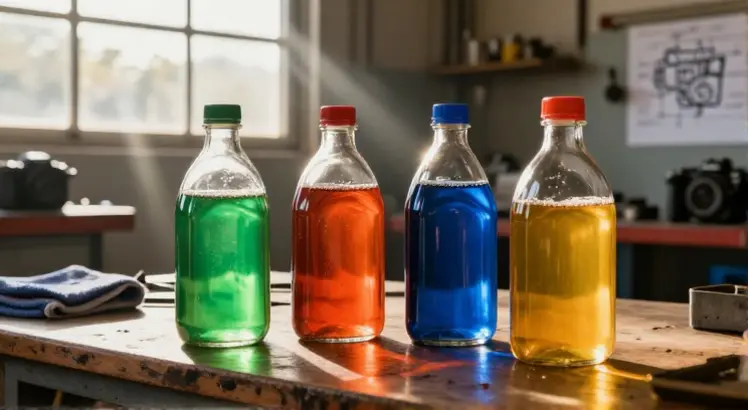
Pop the hood of your car and you will see a translucent plastic reservoir filled with a brightly colored liquid. That fluid is often called antifreeze, but its real job is engine coolant. It stops your engine from freezing in winter, boiling in summer, and corroding from the inside out. If you have ever wondered what are the 4 types of coolant, you are not alone. Walk into any auto parts store and the shelf is a rainbow of green, orange, pink, and blue jugs. Choosing the wrong one can lead to expensive damage, so understanding the core technologies matters.
Every vehicle relies on a specific coolant formulation to protect its unique mix of metals, gaskets, and seals. Using the wrong chemistry can turn your radiator into a science experiment gone wrong. This guide will walk you through the four distinct coolant types, how to identify them, and how to pick the correct one without relying on color alone.
What Is Engine Coolant and Why Does It Matter?

Zerex Asian Vehicle Blue Silicate and Borate Free 50/50 Prediluted Ready-to-Use Antifreeze/Coolant 1 GA (Pack of 2)
Check PriceEngine coolant is a heat transfer fluid that circulates through your engine block and radiator. It absorbs extreme combustion heat and sheds it into the outside air. Without coolant, your engine would seize up in minutes. The base of almost every coolant is either ethylene glycol or propylene glycol mixed with water, but the magic is in the additive package.
Those additives, often called corrosion inhibitors, protect aluminum cylinder heads, cast iron blocks, copper heater cores, and plastic intake manifolds from rust and electrolysis. Manufacturers balance these inhibitors to match the materials inside a specific engine family. Pour in a generic green coolant into a modern European car, and you might dissolve a head gasket over time.
There are two fundamental worlds of inhibitor technology: traditional inorganic salts and modern organic acids. How these are blended defines the four coolant families. Understanding the difference helps you avoid a costly cooling system repair. For a wider look at what this fluid does, you can learn how antifreeze works inside an engine.
The 4 Main Types of Coolant
Zerex Asian Vehicle Blue Silicate and Borate Free 50/50 Prediluted Ready-to-Use Antifreeze/Coolant 1 GA (Pack of 2)
Check PriceThe automotive industry categorizes coolant into four distinct chemical technologies. They are not interchangeable, even if two jugs share a similar shade. Here is the breakdown of each type, its typical lifespan, and where you are most likely to find it.
1. Inorganic Additive Technology (IAT)
IAT is the oldest and most traditional type of coolant. It uses silicates and phosphates to coat metal surfaces and physically block rust. This sacrificial layer does a great job but wears away relatively quickly. That means IAT coolant needs changing every two years or 30,000 miles, whichever comes first.
Classic American cars, older trucks, and vehicles built before the mid-1990s almost always specified IAT. Its most recognizable signature is a bright green dye. While the green color has become iconic, a few heavy-duty diesel formulas use a low-silicate IAT that can appear red, which is why color is not a reliable cheat code.
If you drive a vintage muscle car or a pre-1995 pickup, sticking with a high-quality IAT green coolant is a safe bet. The frequent drain intervals also flush out contaminants before they settle in the radiator. Just never extend the service life, because depleted silicates turn into a sludge that clogs heater cores.
2. Organic Acid Technology (OAT)
OAT coolant took a sharp turn away from silicates. It uses organic acids and carboxylates to chemically neutralize corrosion as it starts, rather than coating everything in a thick protective film. This reactive protection allows OAT to last much longer, typically five years or 150,000 miles. That extended life made it popular with manufacturers aiming to reduce maintenance costs.
General Motors introduced the most famous OAT formula under the Dex-Cool brand in the mid-1990s. It is usually dyed orange or dark red. You will find OAT in many GM, Saab, and some Vauxhall models. The downside is that early OAT formulas gained a bad reputation for turning into a muddy gel if mixed with air or other antifreeze types, giving rise to the dreaded Dex-Cool sludge horror stories.
Modern OAT formulas have solved those early issues, but they still hate being topped off with IAT green coolant. If your vehicle’s cap requires Dex-Cool, stick with it. A key point is that OAT typically avoids phosphates and silicates, making it gentler on certain aluminum alloys that porous European blocks sometimes reject.
3. Hybrid Organic Acid Technology (HOAT)

Zerex G05 Phosphate Free 50/50 Ready-to-Use Antifreeze/Coolant, 1 GA (Pack of 2)
Check PriceHOAT is the bridge between old-school IAT and modern OAT. It uses organic acids for long-life protection but adds a smaller dose of silicates or phosphates for immediate surface coverage. This dual-layer defense combines the instant barrier of IAT with the extended durability of OAT. Most HOAT formulas are specified for five years or 100,000 to 150,000 miles.
European and Chrysler vehicles leaned heavily into HOAT. You will see it dyed yellow, turquoise, pink, or even purple depending on the manufacturer. Mercedez-Benz and BMW fill their cars with a silicate-based HOAT, while many Ford models use a phosphate-based HOAT. Asian manufacturers like Toyota and Nissan also developed their own phosphate-enhanced HOAT coolants, colored pink or blue.
If you own a Toyota, understanding what your vehicle manufacturer recommends before buying any pink fluid off the shelf is crucial. Toyota’s Super Long Life Coolant is a pre-mixed phosphate HOAT that does not mesh well with old-style green IAT. Using the wrong HOAT sub-type can still cause gasket seal failure over thousands of miles, so never guess based on color alone.
4. Phosphate-Free HOAT (P-HOAT)
Zerex Asian Vehicle Blue Silicate and Borate Free 50/50 Prediluted Ready-to-Use Antifreeze/Coolant 1 GA (Pack of 2)
Check PriceP-HOAT, also called Si-OAT or silicate organic acid technology, is a European evolution of HOAT. It uses silicates for quick-acting protection but contains absolutely zero phosphates. This formulation is critical for vehicles with hard water in their cooling systems or those using certain magnesium alloys that phosphates can attack.
Volkswagen, Audi, Porsche, and BMW are the primary users of P-HOAT formulas. These coolants come in a spectrum of colors like violet, pink, or dark blue depending on the specific OEM standard. The G12++, G13, and G40 coolants from VW Group are classic P-HOAT examples. They offer extremely long service intervals, often described as lifetime fill under ideal conditions.
Phosphate-free does not mean chemical-free. These coolants are heavily engineered with advanced organic corrosion inhibitors that do not play well with standard green or orange products. If your European car requires a specific VW G12+ or G13 specification, nothing else will maintain the coolant system warranty. A detailed breakdown of coolant technologies will show just how precise these formulations must be.
How to Identify Coolant by Color, and Why You Shouldn’t

Recochem OEM 86-174POEM Pink Premium Antifreeze Concentrate Extended Life PINK, 1 gallon, 1 Pack , BROWN
Check PriceThe industry’s original intent was simple: green meant IAT, orange meant OAT, and yellow or pink meant HOAT. But over time, aftermarket brands and different OEMs threw that system into chaos. Honda sells a dark blue Type-2 OAT. Toyota Super Long Life is pink, but aftermarket Asian coolants can be pink, blue, or even red. Some heavy-duty OAT coolants are green.
The only reliable way to identify what belongs in your radiator is to read the owner’s manual or the label on the reservoir cap. Look for a specification code like Dex-Cool approved, Ford WSS-M97B44-D, or VW TL 774-J. Matching that code is far safer than matching the color. Ignoring the specification is how radiators turn into a waxy mess.
Which Coolant Type Is Right for Your Car?
Start with the manual. If the book says GM 6277M or Dex-Cool only, grab an orange OAT jug that displays that approval. A Dodge Charger will likely call for an MS-9769 HOAT formula, often dyed purple. A 2015 Audi A4 needs a silicate P-HOAT meeting G12+ or G13 standards, which is typically violet or pink.
For older American iron built before 1995, you can feel confident filling it with a traditional green IAT. If you want to stretch drain intervals on a classic, some premium universal HOAT coolants claim compatibility, but you must do a thorough flush of the entire system first. Never just drain and top-off when crossing technology boundaries.
When an engine runs hotter than it should, choosing a coolant that prevents overheating involves more than picking the right type. You also need the correct water-to-concentrate ratio, a functional pressure cap, and a clean radiator. But the foundation is always the right chemical base for your engine’s metallurgy.
Can You Mix Different Types of Coolant?
Mixing coolant types is a gamble you should avoid. When OAT and IAT mingle, the silicates and organic acids can react to form a brown gel that clogs radiator passages. Even blending two HOAT coolants with different phosphate levels can accelerate corrosion on solder or brass components. The only safe universal product is a clean flush with distilled water followed by a specific approved fluid.
If you are stuck on the road and must top off with whatever is available, use distilled water instead of random coolant. Then have the system flushed and refilled as soon as you get home. A temporary dip in freeze protection is better than a chemical reaction that requires a new heater core.
Frequently Asked Questions
What are the main 4 types of coolant?
The four primary categories are Inorganic Additive Technology (IAT), Organic Acid Technology (OAT), Hybrid Organic Acid Technology (HOAT), and Phosphate-Free HOAT (P-HOAT). They differ in how they prevent corrosion, their service life, and which vehicle brands use them.
Can I use green coolant in a modern car?
Generally no. Green IAT coolant does not last as long and its silicate package can damage seals in engines designed for OAT or HOAT fluids. Stick to the specification in your owner’s manual, not the color.
What color is OAT coolant?
OAT coolant is commonly orange, dark red, or pink. Dex-Cool from General Motors is the most recognizable orange OAT, but some Asian manufacturers fill with pink or blue OAT. Always verify by the label.
How often should I change my coolant?
It depends on the type. IAT generally every 2 years or 30,000 miles. OAT and HOAT can go 5 years or 100,000 to 150,000 miles. Many European P-HOAT systems are considered lifetime fill but should still be checked regularly.
Is universal coolant safe for any engine?
Universal coolants claim compatibility, but they are a compromise. They often work well only if the system is completely flushed first. Mixing them with old IAT or OAT can still reduce protection. For peace of mind, use the exact OEM specification.
Conclusion
Now you know the answer to what are the 4 types of coolant and why grabbing a random jug off the shelf is a risky move. IAT offers traditional protection for older cars, OAT brings extended life for many domestic models, HOAT blends the best of both worlds for Asian and European vehicles, and P-HOAT keeps German engineering running smoothly without phosphates. The rainbow of colors on the store shelf is a tool, but the specification printed on the bottle is your real guide.
Check your owner’s manual, match the exact OEM standard, and stick to sensible drain intervals. Your engine will reward you with years of trouble-free temperature control. When in doubt, a professional flush and fill with the correct formula is far cheaper than a radiator or head gasket replacement down the road.