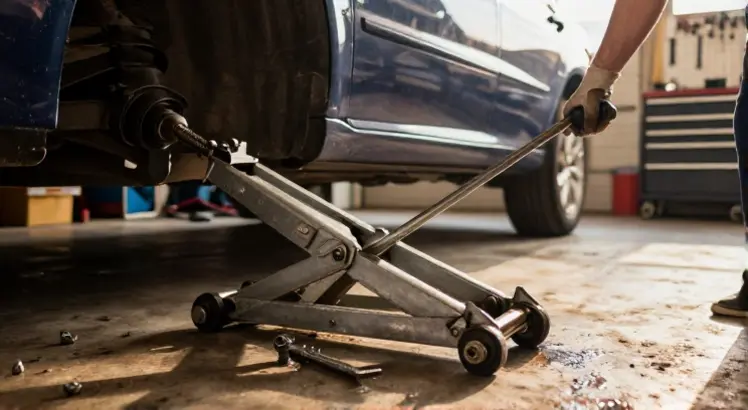
If you have ever had to change a flat tire, you have likely used a scissor jack without thinking much about its clever design. Understanding how does a scissor jack work can help you use this compact tool safely and appreciate its mechanical brilliance. This article unpacks the simple physics, the key components, and the step-by-step lifting process behind these trusty car jacks.
The Core Components of a Scissor Jack
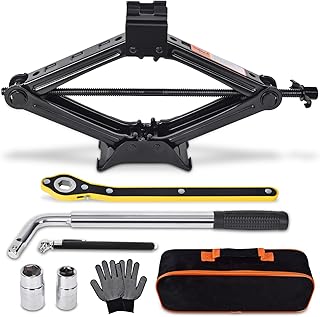
Scissor Car Jack 2 Ton (4409 lbs) Tire Changing Kit with Lug Wrench
Check PriceEvery scissor jack relies on a handful of carefully engineered parts that turn rotational effort into a stable vertical lift. Once you identify these pieces, the entire operation becomes crystal clear.
The Load-Bearing Frame
A diamond-shaped metal frame forms the backbone of the jack. Four rigid arms are connected at pivot points, allowing the shape to collapse flat or expand upward. The top saddle cradles your vehicle’s lifting point, while the wide base plate distributes weight and prevents tipping.
The Central Screw Mechanism
Running horizontally through the center of the frame is a long threaded rod, often called the lead screw or power screw. This is the heart of the lifting action. One end of the screw connects to the crank handle, and a traveling nut rides along the threads, linked to the scissor arms.
The Drive and Pivot Points
The crank handle or lug wrench engages with a small gear or directly with the screw eye. Turning the handle rotates the screw, forcing the nut forward or backward. As the nut moves, the pivot points, often hardened steel pins or rivets, let the arms scissor in perfect synchronization without binding.
The Mechanical Principle: How Screw Threads Create Lifting Force

Scissor Car Jack 3 Ton (6610 lbs) Tire Changing Kit with Lug Wrench
Check PriceThe secret behind the scissor jack is an old but brilliant simple machine: the screw. A screw is basically an inclined plane wrapped around a cylinder. When you rotate the screw, the threads convert rotational motion into a smooth, powerful linear movement of the traveling nut.
This conversion delivers a huge mechanical advantage. The long pitch of the thread allows a small force applied over a long distance, many turns of the handle, to generate a massive force over a very short lifting distance. In a typical scissor jack, the Acme thread is coarse and self-locking, which means even when you stop cranking, the load cannot back-drive the screw downward.
You can get a deeper look at how a threaded rod converts rotational motion into linear force on dedicated mechanical science resources. Every revolution of the handle advances the nut by exactly one thread pitch, and that tiny axial pull gradually opens the scissor frame.
Step-by-Step Lifting Process Explained
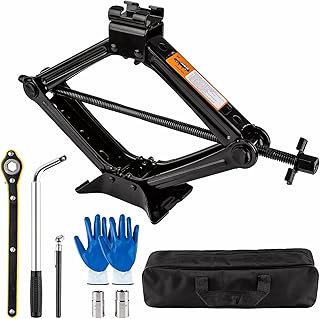
Beaiguna Portable Car Jack Kit, 2 Ton (4409 lbs) Scissor Jack for Car
Check PriceNow let us walk through exactly what happens from the moment you start cranking to the moment a vehicle rises off the ground. Understanding this sequence will also make your ground-level safety checks second nature.
First, the base plate sits firmly on a level surface, and the top saddle locates under the manufacturer’s approved jacking point. As you turn the handle clockwise, the screw rotates inside the threaded sleeve or nut. Because the screw threads are stationary axially, the nut moves along the length of the screw.
The traveling nut pulls the two lower arm ends closer together, while simultaneously pushing the two upper arms farther apart. This creates a classic diamond-expansion effect. The height of the jack increases steadily, and the load begins to transfer upward.
Since the screw pitch is relatively flat, you need many handle rotations to lift just a few inches. That trade-off is exactly what makes the effort so manageable. A 2-ton car can be raised with one hand because the screw converts your 10-pound pull into a lifting force of over 1,500 pounds at the saddle, albeit slowly.
If you want to see the full procedure in a single walkthrough, check this step-by-step guide on using a scissor jack properly. It covers the placement, cranking rhythm, and crucial safety pauses.
Why Scissor Jacks Are So Effective and Compact

IMAYCC Car Jack Kit 2.5 Ton, Universal Scissor Car Jack
Check PriceScissor jacks are the go-to emergency tool in most trunks for a reason. They are entirely mechanical, so there is no hydraulic fluid to leak, no seals to blow, and no bleeding required. The all-steel construction handles high stress cycles reliably, even after sitting unused for years.
The compact, collapsed form hides serious leverage. When folded, the diamond shape keeps the height low enough to slide under a car with a flat tire, typically under 4 inches, which is a feat many bottle jacks cannot match. At the same time, the wide base and wide top saddle provide excellent stability during the lift.
Another often overlooked advantage is the self-locking nature of the screw. Once you stop turning the handle, friction and thread geometry hold the load securely. There is no slow descent like you might experience with a hydraulic jack that has a tiny internal leak. The scissor jack essentially locks in position until you intentionally reverse the rotation.
Scissor Jack vs. Bottle Jack: A Quick Comparison

Scissor Jack 3 Ton, 4.1″-18.3″ Lifting Car Jack, Heavy Duty Car Jack Kit
Check PriceMany drivers wonder whether a scissor jack or a hydraulic bottle jack is better. Both serve the same purpose but work on entirely different principles, and each has its moments of superiority.
- Lifting mechanism: Scissor jack uses a mechanical screw and linkage system. Bottle jack relies on hydraulic pressure to extend a ram.
- Speed: Bottle jacks typically lift faster per pump stroke. Scissor jacks require many handle rotations, making them slower.
- Minimum height: Scissor jacks usually have a lower collapsed profile, which is critical when a flat tire leaves little ground clearance.
- Maintenance: Hydraulic jacks need seal care and fluid checks. Scissor jacks only ask for occasional thread lubrication.
- Weight: Scissor jacks are almost always lighter and easier to stash in a compact spare tire well.
For emergency roadside use, the scissor jack remains the industry standard largely because it never fails due to hydraulic fluid issues. Still, if speed is your priority and you have the storage space, a quality bottle jack can be a worthy upgrade.
Mechanical Advantage and Load Capacity
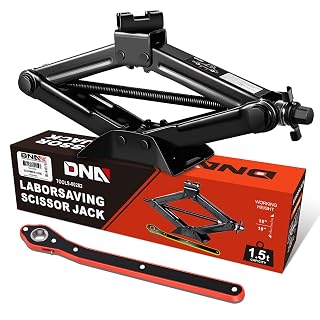
DNA Motoring Scissor Jack for Car, 1.5 Ton (3,306 lbs) with Ratchet Wrench
Check PriceThe lifting magic boils down to a trade-off governed by the screw’s pitch and the linkage geometry. A typical scissor jack screw has a lead (distance per revolution) of about 0.1 to 0.2 inches. With a handle length of 12 inches, the mechanical advantage can exceed 300 to 1.
What does that mean in the real world? It means a human input force of 15 pounds can theoretically generate over 4,500 pounds of lifting capacity minus friction losses. Manufacturers rate scissor jacks conservatively, usually between 1.5 and 2.5 tons, to leave a healthy safety margin for slightly uneven loads and worn threads.
Always check the label on your jack before lifting. Lifting a 3-ton SUV with a 1.5-ton emergency scissor jack can deform the arms, strip the threads, or cause a sudden and dangerous collapse. Matching the jack to the vehicle’s gross axle weight rating is not optional, it is the foundation of safe lifting.
Before you crawl under any vehicle, you must also master proper car lifting techniques that complement the jack’s mechanics. Even a perfectly functioning scissor jack needs a solid partner in correct ground placement and chocking.
Common Mistakes and Safety Precautions
Understanding how a scissor jack works also means knowing how it can fail. Most failures are not equipment defects, they are user errors that put the mechanical design at a disadvantage it was never meant to overcome.
- Soft or sloped ground: A scissor jack requires a flat, hard surface. Soft asphalt or gravel allows the base to sink, shifting the center of gravity and overloading one side of the frame.
- Exceeding lift height: Cranking the jack beyond its maximum safe height hyper-extends the arms. Past a certain angle, the mechanical advantage drops rapidly and the screw can bend.
- No jack stands: A scissor jack is a lifting device, not a support device. Never get under a vehicle supported only by a scissor jack. The self-locking screw is not a substitute for a rated jack stand.
- Off-center loading: Placing the saddle on a slanted suspension part instead of the flat factory jack point can cause the jack to kick out sideways under load.
Before every lift, chock the wheels, set the parking brake hard, and give the scissor jack a quick visual check. Look for bent arms, stripped threads, or a damaged crank eye. A light coating of lithium grease on the screw threads keeps the mechanism smooth and prevents rust binding.
Frequently Asked Questions
How does a scissor jack lift a heavy car with so little effort?
It amplifies your input force through the screw thread’s mechanical advantage. Turning a long handle rotates a screw with a shallow pitch, trading distance for force just like a gear reduction. The sacrifice is speed, you turn many times to lift a few inches.
What is the maximum weight a scissor jack can handle?
Most stock scissor jacks are rated between 1.5 tons and 2.5 tons. That rating is for the entire vehicle weight properly distributed on one corner. Always confirm the capacity stamped on the jack body matches or exceeds the axle load you are lifting.
Why does a scissor jack hold its position without a brake?
The Acme thread shape and the friction between the screw and nut produce a self-locking effect. The friction angle is larger than the lead angle, so the weight of the car cannot back-drive the screw. This property is inherent in the geometry, no extra locking mechanism needed.
Can a scissor jack fail suddenly?
Yes, a scissor jack can fail if overloaded, used on uneven ground, or cranked past its maximum height. Stripped threads or a bent lead screw can cause an abrupt drop. That is precisely why jack stands must be placed before any body part goes under the vehicle.
How do I maintain a scissor jack?
Keep the screw threads clean and lightly lubricated with white lithium grease or general-purpose grease. Check the pivot pins for cracks, and make sure the base and saddle are free of rust pitting. A quick annual inspection is all it takes to keep one working for decades.
Conclusion
Now that you know how does a scissor jack work, you see beyond the simple diamond-shaped metal in your trunk. It is a precision mechanical amplifier that uses screw threads and pivot geometry to turn a small handle force into tons of lifting power. The next time you are changing a tire, take a moment to appreciate the elegance of that thread-driven motion, but always pair that appreciation with rock-solid safety habits. Use wheel chocks, inspect the jack before cranking, and never skip placing jack stands before you get under the car. The physics is reliable, but your safety checklist is the ultimate backup.