
Testing a battery with a multimeter is one of the most practical skills any car owner or DIY enthusiast can learn. Whether your engine is cranking slowly or a household gadget suddenly dies, a multimeter gives you a quick, accurate way to check state of charge and overall health. In this guide you will learn exactly how to test a battery with a multimeter, understand voltage readings, and spot a weak battery before it leaves you stranded.
We cover everything from automotive lead-acid batteries to small AA and AAA cells. You do not need to be an electrician, all you need is a basic digital multimeter and a few minutes. By the end, you will know how to safely measure DC voltage, perform a load test on a car battery, and interpret the numbers with confidence.
Why Use a Multimeter for Battery Testing
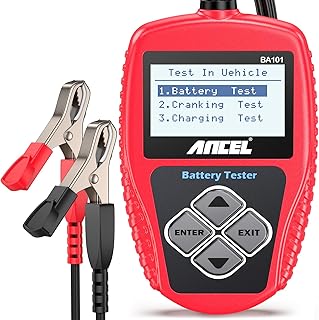
ANCEL BA101 Car Battery Tester, 12V Digital Automotive Alternator Meter Diagnostic Tool
Check PriceA multimeter is a low-cost, versatile tool that reads voltage, resistance, and sometimes current. While dedicated battery testers exist, a multimeter lets you see the exact resting voltage, which is often enough to diagnose a problem. It also allows you to test batteries of different chemistries, from alkaline to lithium, without buying separate testers.
Regular testing helps you catch weak batteries early. In a car, for instance, a battery that consistently reads below 12.4 volts after sitting overnight may be nearing the end of its life. You can also use a multimeter to check if the charging system is working, a simple reading at the terminals with the engine running tells you if the alternator is sending the correct voltage.
If you notice common signs of a failing battery such as slow cranking or dim headlights, a multimeter test is the logical first step before spending money on a replacement. It gives you data, not guesswork.
What You Need Before You Start

TOPDON BT100 Car Battery Tester 12V Load Tester
Check Price- A digital multimeter (auto-ranging makes it easier, but a manual range model works fine)
- Safety glasses and protective gloves, especially for car batteries
- Clean terminals, corrosion can cause false readings
- The battery you want to test, disconnected from any load if possible
For automotive batteries, park the vehicle in a well-ventilated area, turn off the engine, and remove the key. Let the battery rest for at least a few hours, or overnight, so surface charge dissipates and you get a true resting voltage. If you are testing a small household battery, simply remove it from the device.
Setting Up Your Multimeter Correctly

MOTOPOWER MP0515A 12V Car Battery Tester Automotive
Check PriceGetting the right reading starts with the right settings. Most multimeters have a dial with several voltage options. Here is how to configure yours for a DC battery test.
Select DC Voltage Mode
Look for the V with a straight line and a dashed line above it. That is the DC voltage symbol. Do not choose the V with a wavy line, that is AC voltage, used for household outlets. Turn the dial to the 20V DC range if your meter is manual; most car batteries are around 12 volts, so 20V gives enough headroom. For a 1.5V alkaline cell, you can use the 2V or 2000mV range for higher precision.
Plug the Probes In the Right Ports
Insert the black probe into the COM (common) jack. Insert the red probe into the jack labeled VΩmA, or sometimes just V. If your meter has a separate 10A or 20A port for high current, do not use that, you are measuring voltage, not amperage. A wrong connection can blow a fuse or damage the meter.
How to Test a Car Battery with a Multimeter

MOTOPOWER MP0514A 12V Digital Car Battery Tester Voltmeter
Check PriceThis is the most common scenario. A standard 12-volt lead-acid battery should show specific voltages that indicate state of charge. Follow these steps carefully, and always keep the probes steady to avoid accidental short circuits.
Step 1: Turn Everything Off
Make sure the ignition is off, all lights, radio, and accessories are completely shut down. Close the doors so no interior lights stay on. Even a small parasitic draw can lower the voltage by a tenth or two, making a healthy battery look weak.
Step 2: Access the Battery Terminals
Open the hood and locate the battery. In some vehicles the battery is in the trunk or under the rear seat. Remove any plastic covers on the positive terminal. Visually inspect for white or bluish corrosion. If buildup is heavy, clean it with a wire brush and a mixture of baking soda and water before testing, because corrosion adds resistance and causes false readings.
Step 3: Place the Probes on the Terminals
Touch the red probe to the positive battery post (marked with a +) and the black probe to the negative post (marked with a -). Press firmly to get a solid connection. You can also use the terminal clamps, but direct contact with the posts often yields the most accurate result. Keep your hands steady and avoid letting the probes touch each other.
Step 4: Read the Resting Voltage
With the battery at rest, the multimeter display will show a voltage reading. Here is a quick reference for a 12V lead-acid battery at about 80°F (27°C).
- 12.60V to 12.80V: Fully charged, excellent condition
- 12.40V to 12.59V: About 75% charged, still healthy
- 12.20V to 12.39V: Around 50% charged, may need charging
- 12.00V to 12.19V: Only 25% charged, battery is weak
- Below 11.90V: Discharged or dead, possible bad cell
If your reading is 12.0V or lower, charge the battery fully and retest. A battery that cannot hold a charge above 12.4V after a full charge is likely sulfated or worn out. In that case, you might start choosing the right replacement battery based on your vehicle’s specifications and climate.
Step 5: Perform a Crank and Charge Test (Optional but Useful)
A resting voltage alone does not tell the whole story. You can also do a rudimentary load test. Set the multimeter in the same DC voltage setting. Have an assistant crank the engine while you watch the meter. The voltage will drop momentarily. It should not drop below 9.6V during cranking. If it plunges below that, the battery may lack the cold cranking amps needed, even if resting voltage looks okay.
After starting, the voltage at the terminals should rise to between 13.7V and 14.7V, which indicates the alternator is charging the battery. If the voltage remains around 12.6V or lower while the engine runs, the charging system may be at fault, not the battery itself.
Testing Household Batteries: AA, AAA, 9V, and Lithium Coins
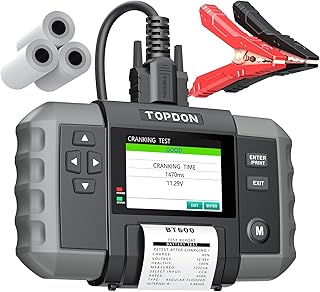
Car Battery Tester, TOPDON BT600 12V, 12V/24V Cranking Tests
Check PriceThe same multimeter can check everyday batteries. For a standard alkaline AA or AAA cell (1.5V nominal), set the meter to the 2V or 2000mV DC range. Touch red to the positive nub and black to the flat negative base. A fresh cell reads around 1.55V to 1.60V. As it discharges, the voltage drops. At 1.35V the battery is nearly depleted. Below 1.2V it is essentially dead.
For 9V rectangular batteries, use the 20V DC range and touch the probes to the top terminals, red to the small (positive) connector, black to the larger (negative) one. A good 9V battery reads above 9.0V. Under 8.0V, it’s time to recycle it.
Lithium coin cells like CR2032 are nominally 3V. Use the 20V range. A reading of 3.0V or slightly above is full, and 2.8V still usable for low-drain devices. Below 2.7V, the cell is weak. Note that lithium batteries maintain voltage flatly until near exhaustion, so even a small drop can signal significant capacity loss.
How to Test a Deep Cycle or Marine Battery

Car Battery Tester 12V 24V, TOPDON BT300P Alternator Tester
Check PriceDeep cycle batteries are built to deliver sustained power and tolerate deeper discharges. The voltage chart shifts slightly. A fully charged 12V deep cycle flooded battery at rest is around 12.70V to 12.80V. At 12.20V, it is about 50% discharged, the recommended minimum for longevity. For AGM (absorbent glass mat) batteries, the fully charged resting voltage is similar, around 12.80V to 12.90V, and 12.30V indicates 50% discharge.
Testing procedure is the same, disconnect all loads, let the battery rest for at least four hours, and measure across the terminals. If the voltage drops quickly after a full charge with no load connected, the battery likely has high internal resistance and may need replacement.
Interpreting Multimeter Readings: Voltage vs. Capacity
Voltage is a helpful indicator but it does not directly measure remaining capacity in amp-hours. A battery can show a decent resting voltage yet collapse under load due to high internal resistance. That is why the cranking test or a dedicated load tester adds more certainty. Still, for quick everyday diagnostics, voltage is reliable enough to flag a problem.
Temperature also affects readings. In cold weather, a fully charged car battery may read slightly lower, around 12.50V, and still be healthy. Always let the battery stabilize to room temperature before comparing to standard charts. If you are testing outside in freezing conditions, know that the chemical reaction slows down, and a reading of 12.3V could still mean a fully charged battery that is just cold.
Multimeter vs. Dedicated Battery Tester
A multimeter measures open-circuit voltage, while a dedicated battery tester often applies a load or uses conductance technology to estimate cold cranking amps and internal resistance. For a more complete health assessment, a professional-grade tester is better. However, a multimeter wins on versatility and cost. It can test any battery type, check fuses, alternator output, and more. Many mechanics start with a multimeter first, then move to a dedicated tester if the voltage hints at a problem.
If you want a deep dive into the science behind multimeter battery testing, check this professional guide from Fluke. It covers advanced topics like internal resistance measurement and safety protocols used in industrial settings.
Safety Tips When Testing Batteries
- Always wear safety glasses and acid-resistant gloves when handling car batteries; they contain sulfuric acid.
- Never smoke or create sparks near a lead-acid battery, explosive hydrogen gas can accumulate around the vents.
- Keep the multimeter leads away from moving engine parts during crank tests.
- If a battery case is swollen, cracked, or leaking, do not test it, replace it immediately and handle with care.
- When testing small lithium cells, avoid shorting the terminals with the probes, even a brief short can generate heat and damage the cell.
Common Mistakes to Avoid
One frequent error is measuring voltage immediately after charging. A battery fresh off a charger holds a surface charge that can read artificially high, like 13.0V. Wait at least a few hours or turn the headlights on for 30 seconds to remove surface charge before testing. Otherwise you might think a failing battery is perfectly healthy.
Another mistake is using the wrong meter range. On manual meters, if you set the dial too low, you may see an over-range indication (OL). That does not mean the battery is overcharged, simply switch to a higher range. Conversely, setting too high a range can reduce precision on small batteries.
Testing a battery while it is still connected to the vehicle with the ignition on or accessories running will give a misleading voltage due to system draws. Always test with the key off and doors closed. And never test a battery by touching the probes to the cable clamps if they are corroded, clean the actual posts or clamps thoroughly first.
Frequently Asked Questions
What should a 12-volt battery read on a multimeter?
A healthy, fully charged 12-volt lead-acid battery should read between 12.6 and 12.8 volts at rest. If it reads 12.4 volts or lower, recharge and retest. A reading under 12.0 volts usually indicates a deeply discharged or failing battery.
Can I test a battery with a multimeter while it is still connected?
Yes, but you must turn off all loads, including dome lights. The vehicle’s computers draw a small parasitic load that can lower the reading by 0.05 to 0.1 volts, which is usually acceptable. For the most precise resting voltage, disconnect the negative cable first.
How do I know if my multimeter is working correctly?
Test it on a known voltage source such as a fresh 9V alkaline battery. It should read near 9.0V. If the reading is erratic, check the probe connections and replace the internal battery of the multimeter if needed. Many cheap meters give inaccurate readings when their own battery is weak.
Can I test a lithium-ion rechargeable battery with a multimeter?
Yes, a multimeter can measure the voltage of 18650, 14500, or other li-ion cells. A fully charged li-ion cell is about 4.2V. Nominal is 3.6V to 3.7V. Do not discharge below 3.0V to avoid damage. Use the 20V DC range. For a battery pack with a BMS, measure at the output terminals.
Does a multimeter test battery life or just voltage?
A multimeter shows voltage, which correlates loosely with state of charge, but it does not directly measure capacity or remaining life. A battery with good voltage can still fail under load. That is why a crank test or a dedicated battery analyzer gives more complete information.
Conclusion
Learning how to test a battery with a multimeter puts you in control of basic diagnostics and saves time and money. You can quickly determine if a battery simply needs a recharge or is ready for retirement, whether in a car, a boat, or a TV remote. The process is safe and straightforward once you understand the voltage ranges and correct meter settings.
Keep this guide handy next time you suspect a weak battery. Start with a clean terminal connection and a rested battery, then let the numbers guide your next move. And remember, a multimeter is just one tool, if your readings are consistently low even after charging, or the battery struggles during cranking, it is time to consider a quality replacement. Use what you learned today to make a confident, informed decision.