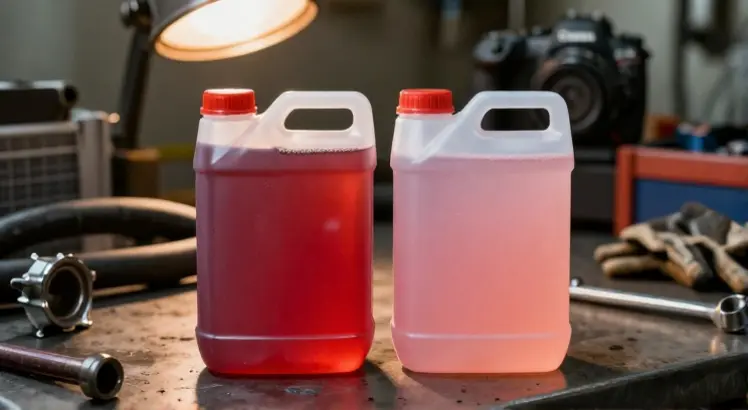
If you own a Toyota, you’ve probably noticed that genuine Toyota coolant comes in two eye-catching colors: red and pink. But don’t let the hue fool you, because the choice between Toyota red vs pink coolant is more than skin deep.
Many owners assume the difference is purely cosmetic, but the color actually signals two distinct chemical formulas and service lives. Grabbing the wrong jug can shorten cooling system life, reduce corrosion protection, and even lead to unexplained overheating. This article untangles the facts so you can confidently pick the right coolant for your engine.
Understanding Toyota Coolant Colors

Toyota Genuine Parts – Antifreeze/Coolant (00272-1LLAC)
Check PriceToyota uses dye not as a marketing gimmick, but as a quick identification tool for its technicians and owners. The factory fill color tells you which inhibitor chemistry is inside. If you’d like a deeper look at how Toyota labels its fluids, check our article on Toyota antifreeze color coding.
Color, however, isn’t a universal standard. For a broader industry perspective, the coolant dye meanings guide from CarTalk explains why a red coolant from one brand might be completely incompatible with a red coolant from another. Toyota’s system is consistent but only within its own ecosystem.
Toyota Red Coolant Explained

Zerex Asian Vehicle Red Silicate and Borate Free 50/50 Prediluted Ready-to-Use Antifreeze/Coolant 1 GA
Check PriceToyota’s red coolant is officially called Toyota Long Life Coolant, or LLC for short. It’s a phosphated HOAT (Hybrid Organic Acid Technology) fluid that relies on a blend of inorganic salts and organic acids to fight corrosion. In most markets, red LLC is sold as a concentrate that must be mixed 50/50 with distilled water before pouring in.
This coolant was the main factory fill for Toyota vehicles built from the mid-1990s through roughly 2004. Models like the 1998–2004 Corolla, 1997–2003 Camry, and early Tacoma pickups left the assembly line with red fluid. Its recommended change interval is 30,000 miles or every two years, whichever comes first.
If your Toyota still runs on red LLC and you maintain it on schedule, the cooling system will stay clean and protected. The phosphated HOAT film plates onto aluminum and iron surfaces, giving solid defense against pitting and electrolysis. However, skipping a drain-and-fill cycle could let the inhibitors wear out and invite sludge.
Toyota Pink Coolant Explained
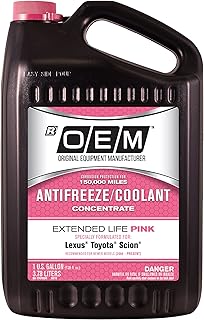
Recochem OEM 86-174POEM Pink Premium Antifreeze Concentrate Extended Life PINK, 1 gallon, 1 Pack, BROWN
Check PriceToyota’s pink coolant is branded as Super Long Life Coolant, or SLLC. It’s also a phosphated HOAT, but Toyota upgraded the organic acid package to extend drain intervals dramatically. SLLC comes from the factory pre-diluted to a 55/45 mix (coolant to water), so you never need to add water; it’s ready to pour straight from the jug.
We have a detailed guide on the Toyota pink coolant formula that covers its chemical makeup and service life. The short version is that pink SLLC was introduced around 2004 and became the factory fill for virtually all new Toyota and Lexus vehicles from that point onward. The first change interval was set at an impressive 100,000 miles or 5 years, after that it’s every 50,000 miles or 5 years.
Because the fluid is pre-diluted, it eliminates the guesswork of mixing concentrate. That convenience, combined with the long life, makes pink SLLC a popular choice even for older Toyotas whose owners are willing to perform a complete cooling system flush first.
Key Differences Between Toyota Red and Pink Coolant
Breaking down the two fluids side by side reveals why Toyota made the switch and why they shouldn’t be treated as equals. Here are the core differences at a glance:
- Color: Red (LLC) vs. Pink (SLLC).
- Chemical base: Both are phosphated HOAT, but SLLC uses a stronger organic acid inhibitor pack for longer life.
- Service interval: Red LLC needs replacement every 30,000 miles or 2 years. Pink SLLC lasts 100,000 miles for the initial fill, then 50,000 miles thereafter.
- Mix requirement: Red is typically sold as a concentrate that requires a 50/50 blend with distilled water. Pink arrives ready-to-use.
- Factory application years: Red appeared mainly in pre-2004 models. Pink became dominant from 2004 onward.
- Protection focus: Red offers reliable protection for shorter cycles. Pink excels at long-haul aluminum and plastic-composite radiator protection.
- Price: Red concentrate is generally cheaper per gallon, but mixing and more frequent changes can erase the savings.
Can You Mix Toyota Red and Pink Coolant?

PEAK OET Extended Life Red/Pink Concentrate Antifreeze/Coolant for Asian Vehicles, 1 Gal.
Check PriceMixing red and pink coolant is not recommended. While both are phosphated HOAT fluids and won’t instantly turn to gel, blending them dilutes the organic acid package that gives pink its super long life. The result is a hybrid fluid that behaves more like red LLC, shortening the protection window and forcing you to change the coolant much sooner than you planned.
If you accidentally top off a red system with pink, or vice versa, don’t panic. In an emergency situation, it’s far better to add any Toyota coolant than to run low. But treat that mixed fill as a red LLC schedule, and plan to flush and refill with the correct fluid within a few thousand miles. Long-term coexistence of the two can lead to imbalanced inhibitor levels and, in rare cases, sediment formation.
The safest approach is to commit to one type. If you’re uncertain what’s already in the system, drain a sample and compare its appearance to a fresh bottle. Still in doubt? A full flush removes all guesswork.
How to Tell Which Coolant Your Toyota Needs
PEAK OET Extended Life Red/Pink Concentrate Antifreeze/Coolant for Asian Vehicles, 1 Gal.
Check PriceColor inside the expansion tank isn’t always a perfect witness, because fluids can fade or previous owners may have changed types. Start by checking the owner’s manual or the coolant reservoir cap label. Toyota often prints Use Toyota Super Long Life Coolant on pink-era cars.
If you find bright red fluid and the car is a 2003 Camry, red LLC is almost certainly the factory fill. But if the car is a 2007 Corolla and the fluid looks dark pink, SLLC is correct. Models built in the transition years may have originally used red but were later refilled with pink at a dealership service.
A VIN decoder can tell you the exact production date, and many Toyota parts desks will look up the recommended coolant by VIN. When buying used, assume nothing; a $20 tester kit from an auto parts store that checks coolant pH and freeze point won’t identify the chemical flavor, but a fresh full flush with the factory-recommended fluid is the most reliable reset.
Tips for Proper Coolant Maintenance
Cooling system neglect is one of the leading causes of head gasket failure and radiator damage. Following a few simple habits will keep both red and pink Toyota coolants doing their job.
- Stick to Toyota genuine coolant or a high-quality equivalent that explicitly states phosphated HOAT approval for Toyota/Lexus.
- Never use generic universal green or yellow coolant, which uses a different inhibitor technology that can react with Toyota seals and aluminum.
- When flushing, always use distilled water, not tap water, to avoid mineral deposits that clog radiators and heater cores.
- Inspect coolant condition at every oil change. Look for rust specks, floating debris, or a brownish tint, all signs that the inhibitors are spent.
- Replace the radiator cap on schedule, because a weak cap lowers the boiling point and invites overheating even with fresh coolant.
Frequently Asked Questions
Can I use aftermarket universal coolant in my Toyota?
Most universal coolants are OAT or NOAT formulas that lack the phosphates Toyota engines need. Using them can lead to aluminum corrosion and water pump seal damage. Unless the bottle specifically lists Toyota/Lexus HOAT compatibility, avoid it.
What happens if I accidentally put green coolant in a Toyota that requires pink?
Green conventional coolant lacks the organic acid inhibitors and phosphates that protect modern Toyota engines. The mixture can accelerate rust, eat at radiator solder, and cause gasket failure. Have the system flushed immediately and refilled with the correct pink SLLC.
How often should I change Toyota pink coolant?
The factory schedule calls for the first drain-and-fill at 100,000 miles or 5 years, whichever occurs first. After that, replace it every 50,000 miles or 5 years. Severe service, like towing or extreme heat, may call for more frequent changes.
Is Toyota red coolant discontinued?
Toyota red LLC is still available at dealerships and aftermarket retailers. It remains a valid choice for older vehicles that originally used it, but pink SLLC is now the primary factory fill across the lineup.
Can I switch from red to pink coolant?
Yes, a full cooling system flush with distilled water allows you to safely switch from red to pink. Do not simply drain and refill without flushing, because leftover red concentrate will contaminate the pink and reduce its long-life properties. A thorough flush ensures the new SLLC performs as designed.
Conclusion
Toyota red vs pink coolant isn’t a fashion statement, it’s a decision that directly impacts your engine’s longevity and corrosion protection. Red LLC works well for older models on a strict maintenance schedule, while pink SLLC delivers modern, worry-free protection for up to 100,000 miles in factory form.
The golden rule is simple: never mix the two and never judge a coolant by color alone. Open your owner’s manual, verify the fluid in the reservoir, and commit to either the original red or the updated pink. When in doubt, a complete flush with fresh Toyota coolant will erase any confusion and give your cooling system a clean bill of health.
Want to dive deeper into specific Toyota fluids? Explore our guides on Toyota pink coolant and Toyota antifreeze color patterns to see how they fit into your maintenance plan.