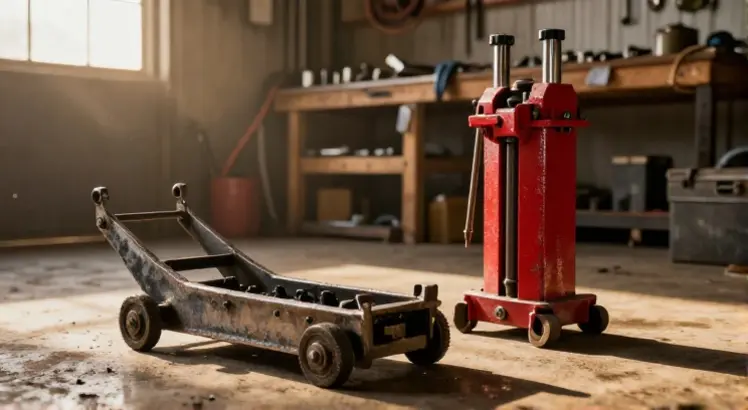
You slide under your truck with a wobbly scissor jack and immediately feel uneasy. Whether you are changing a tire on the side of the highway or lifting a project car in your garage, the tool you grab makes all the difference. The debate between a bottle jack vs trolley jack is one of the most common questions we hear from DIY mechanics. Both tools do the same basic job of lifting a vehicle, but they work in very different ways and suit very different situations. Choosing the wrong one can mean the difference between a quick, safe repair and a frustrating afternoon.
Most drivers start with the emergency jack that came in the trunk, which is almost always a scissor jack. As soon as you need to lift a heavier truck or work on a lowered sports car, you quickly realize you need an upgrade. That is where the confusion between bottle jacks and trolley jacks begins. This guide breaks down the pros, cons, and the best use cases for each so you can invest in the right gear for your garage.
What Is a Bottle Jack?

Torin T90413 Big Red Hydraulic Bottle Jack with Carrying Case, 4 Ton (8,000 lb) Capacity
Check PriceA bottle jack is a compact hydraulic lifting device shaped like a small, stout bottle. It uses a vertical piston that extends upward to lift a load. These jacks are incredibly popular in the truck and SUV community because they offer immense lifting power in a very small footprint. The mechanism relies on hydraulic fluid being pushed through a cylinder, multiplying the force you apply with a long handle.
Bottle jacks come in two main styles. Standard models have a stationary base and a ram that moves straight up. Tall or telescoping models have a two-stage piston, allowing them to start shorter but reach a higher maximum height. This makes them versatile for off-road vehicles with high ground clearance. The simplicity of the hydraulic system means fewer moving parts and often a longer service life if the fluid is kept clean.
The biggest advantage of a bottle jack is raw capacity. A unit that fits in a small storage bag can often lift 20 tons or more, which is far beyond the reach of most portable hydraulic jacks. That is why you see them on logging trucks and heavy-duty farm equipment. However, the vertical-only piston means you need enough clearance under the vehicle to slide the jack in place before you start pumping the handle.
What Is a Trolley Jack?
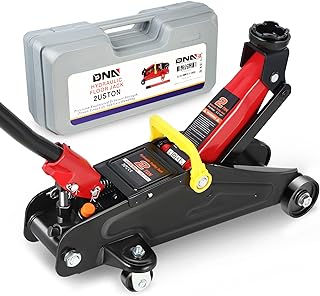
DNA Motoring Low Profile Hydraulic Trolley Floor Jack
Check PriceA trolley jack, often called a floor jack, is the long, low machine you see in professional auto shops. It has a horizontal hydraulic cylinder connected to a lifting arm that swings up in an arc. That arm ends in a large saddle or pad that contacts the vehicle’s frame. The entire unit rolls on four casters, allowing you to position it easily under the car before lifting and then roll the jack slightly as the suspension compresses.
The low-profile design of a trolley jack is its main selling point. Even a racing car with minimal ground clearance can be lifted with a quality low-profile floor jack. The long chassis also provides excellent stability once the vehicle is raised. Since the base is wide and the unit rolls forward with the lifting arc, the saddle stays securely in contact with the lift point without dragging sideways. This reduces the risk of the car slipping off the jack.
Trolley jacks are rated by tonnage just like bottle jacks, but they typically top out around 3 or 4 tons for home garage versions. Professional heavy-duty units exist but are large and expensive. The mechanics of a trolley jack also require more maintenance since you have a hydraulic release valve, a universal joint on the handle, and grease fittings for the wheels. But for anyone working on standard passenger cars, a floor jack feels much safer and more intuitive to use than a bottle jack.
Key Differences: Bottle Jack vs Trolley Jack
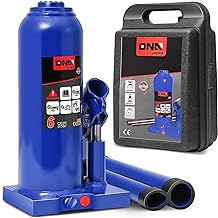
DNA Motoring 6 tons / 13228 lbs Lifting Automotive Welded Hydraulic Bottle Jack
Check PriceUnderstanding the physical trade-offs between these two tools will help you avoid buying the wrong one. It is not about which tool is universally better, it is about which matches your exact vehicle and workspace. The following breakdown covers the most important factors you need to consider before purchasing.
Lifting Capacity and Reach
Bottle jacks crush the competition when it comes to raw lifting force. It is easy to find a compact 12-ton bottle jack for heavy-duty trucks, while a similar capacity trolley jack would be a massive, expensive commercial unit. If you drive a lifted heavy-duty pickup or need to lift a loaded trailer, the bottle jack is the clear winner. The power-to-size ratio is simply unmatched by any other portable jack.
On the other hand, trolley jacks offer superior lift range for cars. They start very low, often as low as 3.5 inches, and can lift a vehicle nearly two feet high. A bottle jack, by contrast, often needs at least 7 or 8 inches of clearance to slide under a frame rail. If you are working on a sedan or a sports coupe, chances are a bottle jack will not even fit under the car. This is the first filter that eliminates many buyers from choosing a bottle jack.
Portability and Storage
There is no contest here, a bottle jack is much easier to store and transport. You can tuck a 10-ton bottle jack behind the seat of a pickup truck or inside a small toolbox on a trailer. It weighs significantly less than a trolley jack of similar capacity. For vehicle recovery kits in remote areas or overlanding, the bottle jack is the preferred tool simply because space and weight are at a premium.
A trolley jack is heavy and awkward. Even a lightweight aluminum racing jack takes up a lot of trunk space and can slide around dangerously if not secured. In a stationary home garage with a dedicated spot on the floor, this is not an issue. But if you plan to carry the jack in your vehicle daily, the trolley jack quickly becomes a noisy, heavy nuisance. A bottle jack with a dedicated storage case is a much cleaner mobile solution.
Stability and Safety
This is the most critical area where the trolley jack excels. A floor jack has a wide stance, a large saddle, and wheels that allow the jack to move subtly with the vehicle as it rises. This prevents the lifting pad from pulling or pushing on the car’s pinch weld. You get a much more planted feeling, and the vehicle is less likely to tilt sideways during the lift.
A bottle jack has a narrow base and a very small contact point on top. It relies purely on the vehicle’s weight pressing straight down to keep the jack stable. If the ground is even slightly soft, uneven, or slanted, a bottle jack can kick out dangerously. Any lateral movement of the vehicle while on a bottle jack can cause a catastrophic failure. Never, under any circumstances, get under a vehicle supported only by a bottle jack. Jack stands are mandatory, as you can read in our detailed guide on proper jack placement for a truck.
Ease of Use
Once you experience a quality floor jack, going back to a bottle jack feels primitive. A trolley jack uses a long lever handle that you pump while standing upright. You do not need to kneel down or crawl under the car to position the handle. The release mechanism is a slow-twist knob that lets you lower the vehicle with precise control. It is ergonomic, clean, and fast.
Bottle jacks require you to be much closer to the ground. You often have to lie on your side to pump the handle when the jack is placed under an axle. Lowering the vehicle requires you to reach a small release valve with a separate tool, which can be nerve-wracking if you need to release it carefully. For a busy mechanic lifting multiple cars a day, the trolley jack saves time and physical strain.
Cost Considerations
A high-capacity bottle jack is surprisingly affordable. You can buy an excellent 12-ton bottle jack for under $50, which makes it the budget king for heavy lifting. If you only need to lift a vehicle a couple of times a year, a bottle jack combined with a good set of jack stands is the cheapest safe setup possible. This low entry price is why many truck owners keep one under the rear seat for tire changes.
A quality trolley jack costs more upfront. A reliable 3-ton steel floor jack from a reputable brand can run between $100 and $250, and a professional-grade aluminum jack can go much higher. However, you are paying for the convenience, safety, and speed of the tool. For regular maintenance like tire rotations and brake jobs, the trolley jack pays for itself in saved time and reduced physical effort.
When to Choose a Bottle Jack

BIG RED T91003B Torin Hydraulic Welded Bottle Jack, 10 Ton (20,000 lb) Capacity
Check PriceA bottle jack belongs in situations where ground clearance is not an issue and lifting capacity is paramount. If you own a lifted truck, a full-size SUV, or a heavy farm trailer, the bottle jack is your best friend. Its compact size allows you to carry it on the vehicle permanently without sacrificing cargo space. This makes it the ideal emergency jack for heavy rigs that a factory scissor jack cannot handle.
Off-road enthusiasts frequently use bottle jacks to lift a vehicle out of ruts when combined with a jack base plate. The high lift range of a telescopic bottle jack can be a lifesaver when a standard jack cannot reach the frame. However, you must always place the jack on a solid, flat surface. Using a wooden block under the bottle jack on soft ground is a mandatory safety practice in these scenarios.
If your workspace is a small shed or a crowded garage, a bottle jack wins the storage battle. It slides onto a shelf without hogging floor space. For apartment dwellers who still do basic maintenance in a shared parking lot, carrying a bottle jack downstairs is much easier than dragging a heavy trolley jack. Pair it with some foldable jack stands, and you have a fully mobile lifting setup that fits in a duffel bag.
When to Choose a Trolley Jack

Jack Boss 3 Ton Low Profile Aluminum and Steel Racing Floor Jack
Check PriceThe trolley jack is the king of the home garage. If you work on regular passenger cars, low-profile sports cars, or even minivans, a floor jack is almost always the superior tool. The low saddle height means you can get under any car with ease. More importantly, the fast pump action gets the vehicle up to working height in seconds, not minutes. This speed is a game-changer when you are rotating all four tires.
Safety is the strongest argument for a trolley jack in a controlled environment. The wide frame and smooth caster movement make the lifting process feel stable and predictable. You can lift from the central front jacking point of a unibody car and slide jack stands under the side pinch welds without the car shifting. Always consult your owner’s manual for the exact lift points, and for additional tips, take a look at our guide on correct jack points for your car.
If you anticipate working on multiple vehicles or see yourself doing brake pads, oil changes, and suspension work, a trolley jack is an investment in your long-term comfort. The ability to quickly lift and lower a car makes the whole process enjoyable rather than a chore. Even if you own a truck, having a 3-ton trolley jack for maintenance at home while keeping a bottle jack in the truck for emergencies gives you the best of both worlds.
Using Either Jack Safely
No matter which jack you choose, a jack is a lifting device, not a holding device. You must use properly rated jack stands before any part of your body goes under the vehicle. Chock the wheels on the opposite end of the car to prevent rolling. Always lift on solid, level concrete when possible. Asphalt can soften in hot weather and cause a jack stand to sink, which is extremely dangerous.
Bottle jacks need extra attention to vertical alignment. If the jack is tilted even a few degrees, the piston can bind and the jack can fail explosively. Trolley jacks need free movement on their wheels to roll forward as the arm arcs up. If the wheels are blocked by a crack in the driveway or a pebble, the jack will pull the vehicle sideways. Following safe jacking practices is the only way to prevent a disaster.
Frequently Asked Questions
Can I use a bottle jack on a standard passenger car?
Most standard cars have too little ground clearance for a bottle jack to slide under the frame or pinch weld. You would need to drive the car onto ramps first, which defeats the purpose of a quick lift. Unless you have a high-clearance vehicle like an SUV or truck, a trolley jack is a much more practical choice for your sedan.
Which jack is better for off-road use?
A bottle jack, especially a larger telescoping model, is far superior for off-road use. It takes up little space in the cargo area and can lift a heavy, lifted truck high enough to change a large tire. You must always carry a wide base plate or a block of wood to prevent the jack from sinking into dirt or mud.
Do I need a trolley jack if I already have a bottle jack and jack stands?
You do not need one, but you will likely want one. A bottle jack can get the job done, but the process is slower and requires more careful setup. If you work under your car frequently, the convenience and speed of a trolley jack will make you reach for it every time, leaving the bottle jack reserved for the roadside kit.
Conclusion
The bottle jack vs trolley jack debate is really a question of where and how you work. A bottle jack is a portable powerhouse that belongs in the emergency kit of every heavy truck and off-road vehicle. It is affordable, compact, and offers incredible lifting capacity for its size. On the other hand, a trolley jack is the unmatched champion of the home garage, offering speed, safety, and a low-profile design that works on practically any car.
Your best bet is to match the tool to the task. If you only have budget for one and drive a truck, start with a high-quality bottle jack. If you own a sedan or coupe, invest in a 3-ton trolley jack. Ideally, having both tools gives you the right equipment for routine maintenance in your garage and for unexpected repairs on the road. Pair whichever jack you buy with sturdy jack stands, and always prioritize safety over speed.