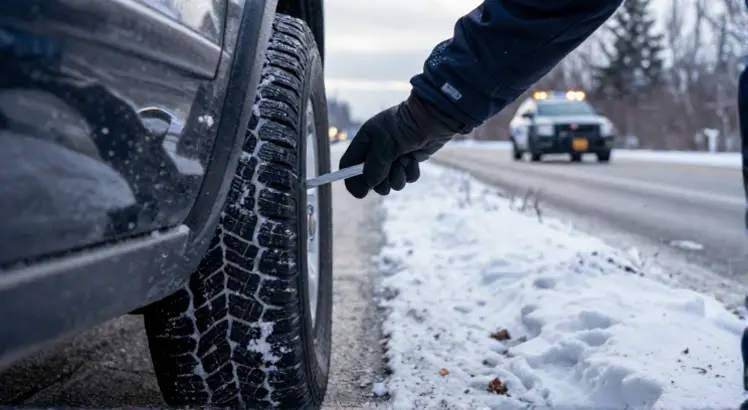
Understanding Canada snow tire law is not as simple as checking a single national statute. Unlike some countries that enforce a blanket winter tire requirement, Canada leaves the decision to each province and territory. This means drivers must know the specific rules where they live and travel. Otherwise, they risk fines, higher insurance premiums, and dangerous driving conditions.
Understanding Canada’s Provincial Winter Tire Regulations

Dunlop Winter Maxx SJ8 225/60R17 99R
Check PriceThere is no federal law that mandates winter tires across the entire country. Instead, individual provinces have introduced their own legislation to address winter road safety. The most well-known is Quebec’s province-wide mandate, but British Columbia, Ontario, and others have specific requirements for certain highways or conditions. Knowing the difference between a legal requirement and a strong recommendation is crucial for every Canadian driver.
Quebec: The Strictest Mandate
Quebec operates the only true province-wide winter tire law in Canada. From December 1 to March 15 inclusive, every passenger vehicle registered in Quebec must be equipped with winter tires that bear the three-peak mountain snowflake symbol. This law applies to all roadways, including city streets and highways, and it covers both residents and tourists driving within the province.
The government introduced this law after studies showed a significant reduction in winter collisions. All-season tires are not considered compliant, even if they carry an M+S marking. The Quebec Ministry of Transport can issue fines to drivers who fail to comply, and the penalty is not just a small ticket. You can face a fine of $200 to $300, plus additional fees, and your vehicle may be prohibited from being driven until proper tires are installed.
British Columbia: Mountain and Highway Requirements

Cooper Evolution Winter 225/65R17 102T Tire
Check PriceBritish Columbia does not have a blanket rule for all vehicles, but it does enforce winter tire requirements on most rural and mountain highways. The law applies from October 1 to March 31 on designated routes, which include the Sea-to-Sky Highway, the Coquihalla, and many interior passes. Passenger vehicles must have tires with at least an M+S marking, while commercial trucks often need the mountain snowflake symbol or carry chains.
Highway signs mark the exact boundaries where winter tires become mandatory. The province uses a tiered system: the M+S symbol is the minimum legal standard for light vehicles, but the three-peak mountain snowflake is strongly recommended for severe conditions. If you ignore the signs and drive without proper tires, you can receive a fine of $121, and if your vehicle causes a blockage or collision, the penalties escalate quickly.
Other Provinces with Winter Tire Laws
Several other provinces have partial regulations or strong recommendations that can affect your legal standing after a crash. In Ontario, winter tires are not mandatory, but insurance companies often offer a discount if you install them. However, some highways in northern Ontario may have temporary winter tire requirements during severe weather events. Manitoba does not require winter tires, but Manitoba Public Insurance strongly encourages their use, and failing to equip your vehicle properly could be considered negligence in an accident claim.
New Brunswick and Nova Scotia do not have a provincial law, but certain mountain passes and rural roads may be subject to travel advisories where winter tires are effectively required for safety. Alberta and Saskatchewan rely on driver discretion, though winter tires are highly recommended for long-distance travel. Always check the current regulations for your province and any province you plan to visit, because failing to comply can affect your insurance coverage and liability.
What Qualifies as a Legal Winter Tire?

Dunlop Winter Maxx 2 Winter 195/65R15 91T Passenger Tire
Check PriceNot every tire with a snowflake on the label meets the legal definition. The standard in Canada relies on two recognized markings: the three-peak mountain snowflake symbol and the mud and snow (M+S) marking. The three-peak mountain snowflake, also known as the severe service emblem, is a pictogram of a three-peaked mountain with a snowflake inside it. This symbol indicates the tire has passed a specific traction test on packed snow and is the gold standard for winter performance.
The M+S marking is a simpler designation that indicates the tread pattern has a certain percentage of void area, but it does not guarantee any minimum snow traction. In Quebec, only the three-peak mountain snowflake is accepted as a legal winter tire. In British Columbia, M+S tires are the minimum legal requirement for passenger vehicles, though the mountain snowflake is preferred. For a complete understanding of how all-season tires compare, you can read whether all-season tires are truly sufficient in snow before making a decision. Transport Canada’s official recommendations also clarify the difference between these markings, and you can review Transport Canada’s winter tire safety guidelines for the most current national advice.
Penalties and Insurance Implications
Fines for non-compliance vary by province, but the financial consequences extend well beyond a ticket. In Quebec, the fine starts at $200 and can rise with additional court costs. In British Columbia, failing to have the appropriate tires on a designated highway can result in a $121 fine, and if your vehicle is involved in a collision or causes a road closure, you could face a much higher penalty. In other provinces, there is no specific winter tire fine, but you may still be charged with driving an unsafe vehicle under the provincial traffic act if your tires are clearly inadequate for the conditions.
Insurance companies pay close attention to winter tire laws. If you are in an accident in a province that requires winter tires and you do not have them, your insurer may deny your claim or reduce your payout. Even in provinces without a mandate, using all-season tires in severe winter weather can be seen as driver negligence. Some insurers offer a winter tire discount, but they also expect you to maintain the tires for the full season. Removing them early or using worn-out winter tires can put your coverage at risk.
Practical Tips for Complying with Snow Tire Laws
Staying compliant is easier when you plan ahead. Start by checking the specific dates for your province and any province you drive through regularly. Mark your calendar for the installation deadline, and schedule your tire changeover early to avoid the rush. Keep a copy of your tire specifications, including the tread depth and the symbol on the sidewall, in your vehicle so you can show proof if questioned by law enforcement.
If you travel between provinces, you must meet the stricter requirement. For example, a driver from Ontario visiting Quebec in February must have winter tires with the three-peak mountain snowflake symbol, even though Ontario has no such law. Tires that are legal in British Columbia using the M+S mark may not be sufficient for a trip to Quebec. To find a set of tires that meets both standards, you can refer to our guide to the best winter tires in Canada for top-rated options that excel in deep snow and icy conditions.
Remember that tire condition is just as important as the symbol. Even a legal winter tire becomes unsafe once the tread depth falls below 4 mm. Inspect your tires monthly, and replace them if you see uneven wear, cracking, or bulges. Store your seasonal tires properly to extend their life. Compliance is not just about avoiding a ticket, it is about protecting yourself and everyone else on the road.
Frequently Asked Questions
Is it mandatory to have snow tires across all of Canada?
No, there is no single national law. Only Quebec has a province-wide mandate for all vehicles. Other provinces, like British Columbia, require winter tires only on specific highways during certain months. The rest of the provinces have no legal requirement, but winter tires are strongly recommended for safety and insurance reasons.
What happens if I drive without winter tires in Quebec?
You can receive a fine between $200 and $300, and your vehicle may be impounded or prevented from moving until winter tires are installed. Insurance companies may also deny coverage if you are involved in a collision without the required tires. The law applies to all vehicles registered in Quebec and to any out-of-province vehicle driving during the mandate period.
Can I use all-season tires with the M+S marking in Quebec?
No, Quebec law requires the three-peak mountain snowflake symbol, which is a higher standard than the M+S marking. All-season tires, even those marked M+S, do not meet the legal requirement. The M+S symbol is only accepted as a minimum in British Columbia, but it is not enough for Quebec’s mandate.
Do winter tire laws affect my insurance?
Yes, they can have a significant impact. If you are in an accident in a province that requires winter tires and you do not have them, your insurer may deny your claim. Even in provinces without a mandate, using inadequate tires can be considered negligence, leading to reduced payouts. On the positive side, many insurers offer a discount for installing winter tires, so it pays to comply.
Conclusion
Canada snow tire law is a patchwork of provincial rules that every driver must understand. The key is to know the exact requirements for the provinces you drive in, not just the one where your vehicle is registered. Quebec demands the three-peak mountain snowflake symbol for all vehicles from December to March. British Columbia enforces either M+S or the mountain snowflake on designated highways from October to March. Other provinces rely on driver discretion, but your insurance coverage may still depend on having proper winter tires.
Before winter arrives, check your tires, verify the markings, and plan your installation. If you travel across provincial borders, equip your vehicle to meet the strictest rule you will encounter. This simple step protects you from fines, keeps your insurance valid, and most importantly, makes winter driving far safer for everyone.