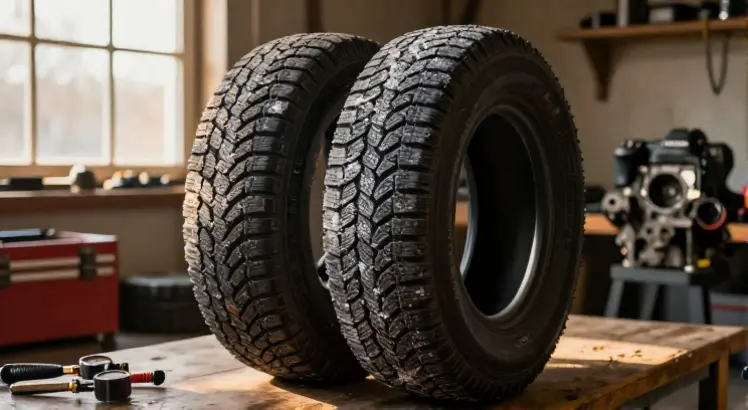
When winter arrives, the debate over 2 or 4 snow tires resurfaces. Many drivers wonder if they can save money by putting winter tires on just the drive wheels. This approach, while common decades ago, misunderstands how modern vehicles and tire technology work. Choosing the right number of snow tires is not about saving a few dollars, it is about preserving control when roads turn slick.
Your safety, the handling balance of your car, and even your ability to stop in an emergency depend on this decision. In this guide, you will learn exactly why four winter tires outperform a set of two in almost every real-world scenario. We will break down the risks, the rare exceptions, and what tire shops often fail to explain.
Why Snow Tires Are Essential for Winter Safety

Goodyear Assurance Finesse All-Season
Check PriceSnow tires, also called winter tires, use specialized rubber compounds that stay flexible in freezing temperatures. All-season tires begin to harden below 45 degrees Fahrenheit, losing grip. Winter tires also feature deeper tread depths and aggressive siping that bite into snow and evacuate slush.
Even the best all-season tire cannot match a dedicated winter tire’s traction on ice and packed snow. This is why many regions with harsh winters mandate winter tires by law. When you search for the best winter tires for your car, you will notice every expert recommends a full set of four.
That recommendation is not just a sales tactic. Tire engineering and vehicle dynamics prove that mixing tire types on the same axle or end of the car creates dangerous handling imbalances. Understanding this is the first step toward making a smart winter driving choice.
The Hidden Risks of Installing Only Two Snow Tires

Travelstar UN33 High Performance All-Season
Check PriceOn the surface, buying two snow tires for the drive wheels seems logical. The engine sends power to those wheels, so you assume grip there is all that matters. However, this overlooks how a vehicle corners, brakes, and reacts to sudden inputs. Here is what really happens when you mount only two winter tires.
Dangerous Oversteer and Understeer Conditions
If you put winter tires only on the front of a front-wheel-drive car, the front grips well, but the rear still wears all-season tires with poor snow traction. During a turn or evasive maneuver, the rear end can slide out uncontrollably. This is called oversteer, and it is extremely difficult to correct on slippery roads.
Conversely, putting snow tires only on the rear of a rear-wheel-drive pickup might give you good forward bite, but the front tires can lose steering grip. The car will push straight ahead when you try to turn, causing severe understeer. Both conditions dramatically raise the risk of a spin or collision.
Uneven Braking Performance
Braking relies on all four wheels. If two tires have excellent snow grip and two do not, the vehicle will brake unevenly. The end with less traction can lock up sooner, triggering ABS intervention that reduces overall stopping power. Even with ABS, the friction imbalance lengthens stopping distances significantly compared to a matched set of four winter tires.
Suspension and Drivetrain Stress
Different tire diameters, tread flex patterns, and grip levels create constant speed differences between axles. This forces your differentials and stability control systems to work overtime. Over a winter season, that added strain can lead to premature wear on expensive drivetrain components. The money saved on two tires may vanish with a single repair bill.
According to winter driving safety guidelines from NHTSA, mixing tire types remains one of the most overlooked causes of cold-weather accidents. The organization stresses that a matched set of four winter tires is the safest configuration for any passenger vehicle.
When Two Snow Tires Might Be Acceptable (and When They Absolutely Are Not)

Firestone Winterforce 2 Winter/Snow
Check PriceThere is a tiny window where installing only two winter tires could be considered a temporary stopgap, not a permanent solution. Understanding this nuance prevents drivers from making a dangerous assumption.
- Emergency situation: If you are stranded after an unexpected early snowfall and can only afford two tires, you might mount them on the drive axle to get home safely. This is a short-term fix until you can complete the full set.
- Very low-speed farm or industrial use: Some agricultural vehicles operate exclusively on private property at crawling speeds. In that niche case, two snow tires on the drive wheels may suffice, but this does not apply to public road driving.
- Historical misconception: Decades ago, many drivers routinely put snow tires only on the rear wheels of rear-wheel-drive cars. Tire technology and vehicle dynamics have evolved enormously since then. Modern stability control, all-wheel-drive systems, and tire designs render that old practice unsafe today.
For any passenger vehicle driven on public roads at normal speeds, two snow tires are never the safe choice. The risks to you, your passengers, and other road users far outweigh the upfront cost savings.
Why All Four Corners Should Wear Winter Rubber

Starfire Solarus AS All-Season
Check PriceInstalling four snow tires creates a balanced, predictable vehicle. This balance is not just a marketing point, it is physics. Here is why four matching winter tires deliver a completely different winter driving experience.
Consistent Cornering Grip
When all four tires share the same tread compound and pattern, your car responds uniformly to steering input. You can feel the limits of grip building up progressively, giving you time to react. A mixed set often breaks away suddenly and without warning, which is a recipe for panic on icy curves.
Maximum Braking Performance
A full set of snow tires can stop up to 30 percent shorter on ice compared to a mixed setup. Those extra few feet of stopping distance are often the difference between a near miss and a serious crash. Emergency braking in winter demands all four contact patches work together equally.
Confidence on Black Ice and Slush
Winter roads are rarely uniformly slick. You might hit a patch of black ice under an overpass while the rest of the road is just wet. Four winter tires ensure you do not have a weak axle that suddenly loses grip in these unpredictable conditions.
When selecting your set, consider top-rated SUV winter tires if you drive a taller or heavier vehicle. The same four-tire rule applies to crossovers and trucks. Weight transfer in taller vehicles makes an unbalanced setup even more unpredictable.
2 vs 4 Snow Tires: A Direct Comparison

Lexani Quattro Tempo Tour AW All-Weather
Check PriceTo make the differences crystal clear, here is a side-by-side look at how two snow tires stack up against four in critical winter driving metrics.
- Forward acceleration on snow: 2 tires provide decent traction on the drive wheels, but 4 tires offer no significant advantage unless all wheels are powered. However, acceleration is just a small part of winter driving.
- Cornering stability: 2 tires create a constant risk of the non-winter axle sliding out. 4 tires keep the vehicle neutral and predictable through turns.
- Braking on ice: 2 tires cause an imbalance that extends stopping distances. 4 tires deliver the shortest, most controlled stopping possible with winter rubber.
- Deep snow traction: 2 tires can dig in and risk getting stuck if the other axle drags. 4 tires help the vehicle float and claw through deep snow without the helpless dragging effect.
- Insurance and liability: Some insurance policies may question a claim if an accident occurs with mixed tire types. 4 winter tires show you took reasonable precautions.
The data is overwhelming. A full set of four snow tires transforms your vehicle into a competent winter machine. Two tires give a false sense of security that often ends badly.
The All-Wheel-Drive Trap: Why AWD Still Needs Four Snow Tires

Mastertrack M-TRAC CUV All-Season
Check PriceMany drivers believe that all-wheel drive or four-wheel drive eliminates the need for four winter tires. This myth is dangerously persistent. AWD helps you accelerate by sending power to all four wheels, but it does not improve braking or cornering grip on its own.
AWD with all-season tires will still struggle to stop on ice. In fact, the extra confidence AWD gives can lead to higher speeds, making the lack of winter tire grip even more catastrophic when you need to turn or brake quickly. Only four winter tires give your AWD system the traction it needs to work properly.
If you put just two snow tires on an AWD vehicle, the drivetrain will constantly fight the difference in rolling speeds. This can overheat the center differential and cause expensive damage. The vehicle’s traction control may also intervene unpredictably, cutting power when you need it most.
Tire Position Rules for Those Considering Only Two Snow Tires
If, despite all warnings, you decide to mount only two winter tires as a temporary measure, the position matters critically. Always put the best tires on the rear axle. This is the universal recommendation from tire manufacturers and safety organizations, even if your car is front-wheel drive.
The logic is simple: most drivers cannot control oversteer, while understeer is more intuitive to manage. When the rear tires lose grip, the vehicle tends to spin, which is far more dangerous than the front end washing out. Keeping the rear planted gives you a fighting chance.
However, this rule only minimizes the hazard, it does not remove it. The safest action is to fit four winter tires and avoid the ugly compromise altogether.
Cost Concerns vs. Safety: Do Four Snow Tires Really Save You Money?
The upfront cost of four winter tires plus mounting or a second set of wheels is a real barrier for some. Yet, viewing this as an expense rather than an investment can be misleading. Here is how four winter tires can make financial sense over time.
- Extended summer tire life: When you run a dedicated winter set, your all-season or summer tires get a break for several months each year. This doubles the lifespan of your warm-weather rubber.
- Fewer accidents: Even a minor fender bender in winter can exceed the cost of two extra snow tires many times over. Avoiding one incident pays for the full set.
- Insurance discounts: Some insurers offer a premium reduction if you install four winter tires. The savings vary, but a quick call to your agent might reveal an immediate benefit.
- Resale value of wheels: A winter wheel and tire package holds decent resale value if you sell the car or no longer need them.
Skipping the rear snow tires saves a hundred or so dollars in the short term, but it risks a lifetime of regret if you lose control. The math favors four tires every time.
What Tire Shops Often Fail to Tell You
Some tire shops will quietly sell you just two winter tires upon request without pushing back. They might assume you know your vehicle best. What they might not explain is that many tire manufacturers void warranties on mixed winter set installations. The uneven wear and stress can be considered improper use.
Additionally, modern stability control systems calibrate themselves based on consistent tire behavior across all four corners. Mixing tire types can confuse these systems, making them less effective when you need them to save you. Four matching winter tires keep your vehicle’s safety electronics happy and accurate.
Frequently Asked Questions About 2 or 4 Snow Tires
Can I put snow tires on just the front of my front-wheel-drive car?
You can, but it is unsafe. The front will grip strongly while the rear has almost no traction on snow or ice. This imbalance causes the back end to swing around without warning. Rear-end slides are extremely hard to catch, especially for everyday drivers.
Is it illegal to drive with only two winter tires?
In most places, it is not explicitly illegal to have mismatched winter and all-season tires. However, if an accident occurs and investigators determine that your mixed tire setup contributed to loss of control, you could be found at fault. Some jurisdictions with winter tire laws require all four tires to match the legal definition of winter tires.
Do two snow tires help at all in light snow?
Two snow tires do improve acceleration traction on slush or light snow compared to four all-season tires. But the moment you steer or brake, the non-winter tires become a major liability. The false sense of security often leads drivers to go faster than conditions allow, making the imbalance even more dangerous.
What about using snow socks or chains on the non-drive axle instead of two extra tires?
Snow socks or chains can provide temporary help on the axle without winter tires, but they are not a replacement. They wear quickly on bare pavement, have speed limitations, and still do not offer the balanced, permanent traction of four dedicated winter tires. They are best used as emergency tools on all four wheels, not as a two-tire substitute.
Does all-wheel drive mean I can get away with two snow tires?
No. AWD helps you go, but it does not help you stop or turn. The increased traction under acceleration can make drivers overconfident. Without four winter tires, an AWD vehicle will have the same braking and cornering weaknesses as any two-wheel-drive car. Plus, the drivetrain can suffer damage from the tire mismatch.
The Bottom Line: Make the Full Set a Priority
After weighing all the physics, real-world crash data, and expert advice, the verdict is clear. Installing 2 or 4 snow tires is not a financial choice, it is a safety choice where the answer must always be four. Two snow tires create a vehicle with a split personality that can betray you in the worst possible moment.
If budget is tight, consider buying a used set of four matching winter tires from a reputable seller, or look for seasonal discounts. Even budget-friendly winter tires in a full set outperform the most premium winter tire if only two are mounted. Peace of mind on icy highways is worth the extra effort.
Save up, buy four, and schedule the swap before the first storm. Your car will handle like it was designed to, and you will arrive safely no matter what winter throws at you.