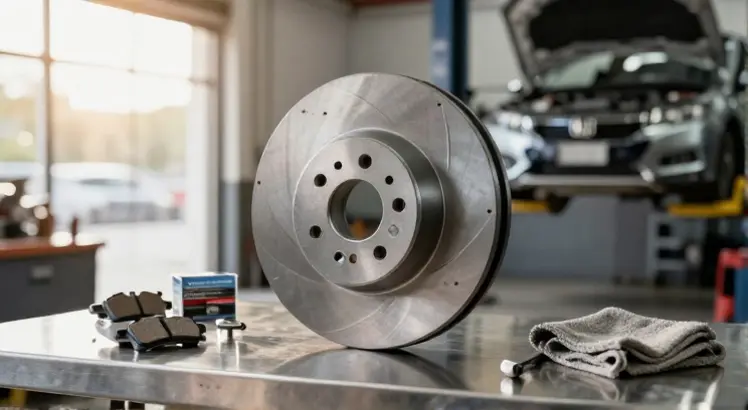
If you drive a Honda Accord, Civic, CR-V, or Pilot, you have probably asked yourself this question when your brake pads wore down: Are Honda OEM rotors good enough, or should I save money on aftermarket parts?
The answer is not always black and white. Original Equipment Manufacturer rotors are built to identical specifications as the ones that left the factory, but that does not automatically mean they are the best choice for your driving style or budget. Understanding where OEM rotors shine, and where they fall short, will help you make a confident decision.
This guide cuts through the marketing noise. We will look at material quality, durability, noise dampening, warranty, and cost. You will learn exactly when sticking with genuine Honda rotors makes sense, and when an upgrade to a premium aftermarket set is the smarter move.
What Exactly Are Honda OEM Rotors?

Detroit Axle – Brake Kit for 2008-2012 Honda Accord, Disc Brake Rotors and Ceramic Brakes Pads
Check PriceHonda OEM rotors are brake discs manufactured or approved by the Honda Motor Company and sold through authorized dealership parts counters. They are the same components installed on the assembly line in Marysville, Ohio, or Suzuka, Japan, depending on your model. OEM stands for Original Equipment Manufacturer, and in this context, it means the rotors are engineered specifically for your vehicle’s weight, power, and brake caliper characteristics.
Unlike generic parts store rotors that may claim to fit dozens of vehicles, a genuine Honda rotor has a single part number that maps directly to a specific trim level and production date range. The metallurgy, cooling vane design, and friction surface are all validated through tens of thousands of miles of internal testing.
It is worth noting that Honda does not operate its own iron foundries. Suppliers like Akebono or Nisshinbo often produce these discs, but to an exclusive set of Honda blueprints. That means you are buying a part with tightly controlled runout and hardness characteristics, not a rebranded generic casting.
Are Honda OEM Rotors Good? A Detailed Quality Check

Detroit Axle – 8pc Brake Kit for 2013-2017 Honda Accord Disc Brakes Rotors Ceramic Pads
Check PriceYes, Honda OEM rotors are good, particularly if your chief priorities are zero noise, a perfect fit, and predictable, fade-resistant braking under normal driving conditions. For the average commuter who never pushes their sedan hard or tows a trailer, OEM rotors deliver a quiet, smooth, and remarkably long service life.
Honda engineers obsess over Noise, Vibration, and Harshness (NVH). The hat area of an OEM rotor often includes specific rubber dampening inserts or specialized geometry to cancel out high-frequency squeal. Aftermarket rotors rarely replicate these subtle anti-noise features with the same precision.
Material consistency is another strong point. OEM rotors are typically a G3000 grade grey iron, but the carbon and silicon content is held to a stricter band than most aftermarket budget options. This consistency minimizes hard spots that can cause pedal pulsation, commonly known as warped rotor sensation, over the first 20,000 miles.
The Metallurgical Advantage
Genuine Honda rotors undergo a specific heat-treating process to relieve internal stress in the casting. A rotor that is not properly stress-relieved will distort microscopically under high heat cycles, leading to thickness variation. OEM quality control rejects rotors that exhibit runout beyond 50 microns, while budget aftermarket lines often allow looser tolerances.
- High scrap rate during casting ensures only dense, void-free metal reaches the assembly line.
- Corrosion protection includes a geomet-coated hat and vane surfaces to prevent rust jacking between the hub and rotor.
- Weight optimization reduces unsprung mass, a detail that directly improves ride comfort and suspension responsiveness.
The Key Benefits of Sticking with Genuine Honda Brake Discs

Detroit Axle – 10pc Brake Kit for 2017-2025 Honda CR-V, Disc Brake Rotors Ceramic Brake Pads
Check PriceThere is a reason many independent Honda specialists refuse to install anything else. The benefits are tangible, especially on models with sensitive electronic brake force distribution and traction control systems that rely on consistent wheel speed signals.
Flawless Fitment Every Time
OEM rotors slide over the hub studs with zero resistance. The height of the hat (the center section) is exact, so the rotor sits perfectly centered in the caliper bracket. With aftermarket parts, a difference of even half a millimeter in the hat offset can cause the pad to overhang the friction ring or drag on the caliper bridge, creating constant heat and wear.
Superior Noise Dampening
No one likes a brake squeal that sounds like a school bus. Honda incorporates specific chamfers on the pad contact surface and uses a precise cross-hatch finish on the friction ring to bed pads quickly and silently. The composite shims used on OEM pad kits, which are often sold in a matching set with rotors, are tuned for the natural frequency of the OEM disc, canceling vibrations before they become audible.
Long-Term Corrosion Resistance
The non-friction surfaces on a genuine Honda rotor receive a durable silver or black electro-deposition coating. This coating prevents the unsightly orange rust blooms that plague many cheaper rotors on the outer edges and inside the vanes. In salt-belt states, this coating alone often extends the functional life of the rotor by a full year or more before structural rust sets in.
Drawbacks to Consider Before You Buy OEM Rotors

R1 Concepts Front and Rear Brake Kit Fits 2018-2025 Honda Accord
Check PriceNo product is perfect. While OEM rotors excel in refinement and consistency, they do have limitations, especially if your Honda sees aggressive driving, mountain descents, or heavy cargo use.
Higher Initial Purchase Price
A single front OEM rotor for a Honda Pilot can cost nearly twice as much as a mid-grade aftermarket alternative from a reputable brand like Raybestos or Centric. When you factor in the cost of factory pads and the dealership list price, a complete brake job with genuine parts often runs 40 to 60 percent higher than using premium aftermarket components from a parts store.
Thermal Limits Under Extreme Use
Honda designs its passenger car rotors for quiet, efficient daily driving. If you frequently descend steep canyons, track your Civic Si, or tow near the limit with a Ridgeline, the solid-faced or simple ventilation patterns may not evacuate heat fast enough. A high-carbon aftermarket rotor with directional internal vanes and drilled or slotted faces will resist fade more effectively in those severe-duty scenarios.
Limited Availability for Older Models
For a 2005 Accord or an older CR-V, OEM rotor stock can dwindle. Dealers sometimes supersede parts, leaving you with a design that has changed slightly. In these cases, a high-quality aftermarket option that adheres to the original spec can be equally dependable and easier to obtain the same day.
OEM Rotors vs. Aftermarket: A Point-by-Point Comparison

PowerStop Front and Rear Brake Kit for Honda Civic 2016-21 – KOE7574
Check PriceTo clarify the practical differences, here is how genuine Honda rotors stack up against the two most common aftermarket categories: premium daily driver discs and performance-oriented upgrades.
- Fit and Tolerances: OEM rotors have unbeatably tight runout from the box, often under 0.001 inches. Premium aftermarket brands like Centric Premium match this, but budget lines frequently exceed 0.003 inches, which can cause subtle pulsation.
- Vane Design: Most Honda OEM rotors use simple pillar or straight vane designs. Higher-end aftermarket rotors feature directional curved vanes that pump air more efficiently, lowering temperatures by 50 to 100 degrees Fahrenheit under repetitive braking.
- Noise Characteristics: OEM is the clear winner. Aftermarket rotors may need a break-in compound or an added layer of Molykote on the pad backing to stay silent, and even then, they can develop a slight groan during light pedal application.
- Warranty: Honda provides a 12-month, 12,000-mile warranty on parts purchased over the counter. Some aftermarket brands, like PowerStop and Wagner, offer limited lifetime warranties against warping and cracking, giving them a strong advantage for long-term owners.
If you lean towards keeping everything factory-fresh, our guide on the top Honda rotor and pad combinations breaks down the exact part numbers to look for. For Odyssey owners facing warped front discs, we have also narrowed down the best brake rotors designed for that specific minivan, including OEM and high-quality alternatives.
When Should You Definitely Choose OEM Rotors?
There are specific situations where spending the extra money on a genuine Honda part is not just preference, it is the wisest mechanical decision you can make.
- You own a car under warranty or lease: A dealership inspection will look for non-OEM parts. While Magnuson-Moss law protects you, avoiding any dispute is simpler with factory parts.
- You are sensitive to brake noise: If any high-pitched squeak drives you crazy, pay for the factory noise tuning. OEM pad and rotor kits are the quietest combination you can install.
- You perform gentle, city-biased driving: Stop-and-go traffic demands smooth initial bite and consistent cold friction. OEM rotors and pads are optimized for exactly these low-temperature braking events.
- You plan to keep the car long term in a harsh climate: The superior anti-corrosion coating on OEM hats and edges resists rust jacking, a common cause of pedal pulsation in northern regions where roads are heavily salted.
Installation Tips to Get the Most from Any Rotor
Even the best Honda OEM rotors will fail early if installed incorrectly. Whether you work on your car in the garage or rely on a mechanic, these steps ensure maximum service life.
Clean the Hub Face Thoroughly
Use a wire brush or a hub cleaning kit to remove every speck of rust and debris from the wheel hub. A tiny spec of rust trapped between the hub and the rotor hat will create lateral runout, mimicking a warped rotor after just a few thousand miles. Always apply a thin, even coat of anti-seize to the hub mating surface to prevent future bonding.
Use a Torque Wrench on the Lug Nuts
Uneven lug nut torque distorts the rotor hat and, over time, the entire disc. Tighten all five lugs in a star pattern to Honda’s specified value, typically 80 to 94 pound-feet depending on the model. Never use an impact gun for final tightening.
Perform a Proper Bed-In Procedure
New rotors need a thin, uniform layer of pad material transferred to their surface. Accelerate gently to around 40 mph, brake moderately to about 10 mph without stopping completely, and repeat six to eight times. Then drive for ten minutes without braking to let the system cool. This lays down a friction layer that prevents judder.
Frequently Asked Questions
Do Honda OEM rotors last longer than aftermarket?
Under identical driving habits, a Honda OEM rotor will often outlast a budget aftermarket disc by 10,000 to 20,000 miles due to tighter metallurgy and better corrosion protection. However, premium aftermarket rotors from brands like Akebono or Brembo can match or slightly exceed OEM lifespan when chosen correctly.
Can I mix Honda OEM rotors with aftermarket brake pads?
Yes, but it requires care. The friction material must be compatible. Ceramic pads pair smoothly with OEM rotors and keep noise low, while semi-metallic pads may generate more dust and slight groan. For the quietest result, use the matched OEM pad set, which includes the correct shims and anti-rattle springs.
Why are Honda OEM rotors so expensive?
The added cost comes from the rigorous quality control, the genuine noise-dampening engineering, and the specialized corrosion-resistant coating. You are also paying for Honda’s validation testing, which ensures the rotor communicates properly with the ABS and VSA stability control modules without false activation.
Are OEM rotors made by Akebono or Brembo?
Honda sources rotors from several tier-one suppliers, including Akebono, Nisshinbo, and sometimes Brembo on performance models like the Type R. The exact manufacturer varies by region and production year, but all are held to the Honda material specification, which remains consistent regardless of the supplier.
A deeper analysis of the cost versus benefit can be found over at OEM brake components cost analysis, which explains the engineering differences in plain terms.
Final Verdict on Honda OEM Rotors
Honda OEM rotors are indeed good, often exceptional, at delivering a quiet, vibration-free, and long-lasting braking experience for daily drivers. They are the gold standard for anyone who prioritizes a dealership-fresh feel and minimal hassle over absolute braking performance or initial purchase price.
If you drive a family sedan, an Odyssey loaded with kids, or a CR-V that sees occasional highway trips, the factory rotors will serve you faithfully for 50,000 to 70,000 miles while keeping the cabin library-silent. They are a set-and-forget solution that aligns perfectly with Honda’s engineering philosophy of refined, predictable operation.
However, if you find yourself repeatedly warping rotors on long mountain grades, or if you simply want the most modern high-carbon alloy for a bit more bite, a top-tier aftermarket option can be a sensible upgrade. In that case, choose a product with a lifetime warranty against warping and a directional vane design, and always replace the pads at the same time to keep the friction couple balanced.
Remember that the rotor is only half the equation. Fresh brake fluid, properly lubricated caliper slide pins, and correct installation torque matter just as much as the disc itself. Treat the whole system right, and your Honda will stop securely and smoothly, whether you opted for that brown box with the red Honda label or not.