If you have ever searched for replacement brakes for your Honda, you have probably wondered who actually manufactures those parts stamped with the H logo. You are not alone. Many owners want peace of mind, wanting to know exactly who makes Honda OEM rotors before they spend their hard-earned cash on a brake job.
The short answer is that Honda does not cast a single brake rotor in its own factories. Instead, the company partners with a small circle of elite Japanese and global braking specialists to produce Original Equipment Manufacturer parts. Understanding this supplier network helps you make smarter decisions, whether you are buying directly from a dealer or shopping for the best aftermarket alternatives.
The Truth About Honda OEM Rotors: It Is a Partnership

Detroit Axle – Brake Kit for 2005-2010 Honda Odyssey Drilled and Slotted Disc Brake Rotors
Check PriceMany drivers assume a Honda OEM rotor comes exclusively from a single secret source. In reality, Honda uses a multi-supplier strategy. Depending on the vehicle model, the production year, and the specific plant where the car was assembled, the rotor stamped with the Honda genuine part number could come from one of several world-class manufacturers.
This strategy guarantees supply chain stability and ensures the highest quality standards are met. Honda sets the engineering specifications, and the suppliers must match them exactly. The result is a product that delivers consistent pedal feel, low noise, and long life, exactly what you expect when you drive a Honda.
Primary Supplier: Akebono Brake Corporation
If you were to pull a genuine brake rotor out of a Honda box today, there is a very high chance it was manufactured by Akebono. This Japanese company is arguably Honda’s most trusted braking partner. In fact, Akebono, one of Honda’s main OEM suppliers, has been developing advanced friction materials and braking components for the brand for decades.
Akebono is known for its ceramic brake technology and its strict adherence to OEM tolerances. Their rotors are engineered to perfectly match the brake pads they often supply alongside them. This synergy is why many Honda owners notice a smooth, linear braking performance right from the first stop. When you install an Akebono-made Honda rotor, you are essentially putting on a part that was validated on the very same assembly line.
Secondary Partners: Nissin and Brembo
While Akebono dominates the mainstream lineup, performance and heavy-duty applications often call for other big names. For models like the Civic Si, Type R, or certain Acura platforms that share Honda architecture, the supplier list expands significantly.
- Nissin Kogyo (Nissin Brake): A giant in the motorcycle and automotive brake world, Nissin supplies master cylinders, calipers, and rotors for many Honda models. Their metallurgy ensures excellent heat dissipation, a critical factor for heavier vehicles like the Pilot or Passport.
- Brembo: If you spot a high-performance Honda with drilled or slotted rotors from the factory, Brembo is likely behind them. Brembo’s reputation in motorsport makes them the go-to for Honda’s sportiest applications.
It is important to note that even when Brembo supplies the rotor, the part still meets Honda’s unique balance of performance and daily drivability. You get a track-inspired component that does not sacrifice cold-bite stopping power during your morning commute.
Other Manufacturers in the Supply Chain
Occasionally, you might see OEM rotors sourced from ADVICS (a Sumitomo Electric company) or Hitachi Automotive Systems. These suppliers are more common in specific regional manufacturing hubs. Honda’s global network means a CR-V built in Ohio might technically have rotors from a different Tier-1 supplier than one built in Japan, but both meet the identical OEM blueprint.
How to Identify Genuine Honda OEM Rotors

Detroit Axle – Front Brake Kit for 2005-2010 Honda Odyssey Ceramic Pads
Check PriceKnowing who makes Honda OEM rotors is only half the battle. Because there are so many counterfeits in the market, you need to be able to spot the real deal. A genuine rotor is not just about the metal disc, it is about the entire manufacturing discipline.
- Packaging and Stickers: Genuine parts come in a Honda-branded box, usually white and blue or red, with a holographic security seal. The label includes the exact part number matching Honda’s electronic parts catalog.
- Stamping and Casting Marks: Look at the rotor’s top hat (the center section). You will find a manufacturer’s mark, often AK for Akebono or a subtle Nissin stamp, alongside the Honda part number and minimum thickness specification.
- Non-Directional Finish: Genuine Honda rotors have a specific cross-hatch, non-directional finish that promotes even pad bedding. Cheap knockoffs often skip this precision grinding step.
If the price seems too low and the box looks photocopied, avoid it. For help selecting a full brake kit that includes genuine-style hardware, you can read our guide on the best Honda OEM rotors and pads for consistent stopping power.
OEM Rotors vs. Aftermarket: Which Should You Choose?
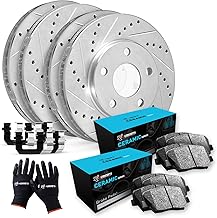
R1 Concepts Front and Rear Brake Kit Fits 2005-2010 Honda Odyssey
Check PriceNow that you know the big names behind the H logo, the next logical question is whether you should stick with Honda-branded boxes or explore the open market. The decision hinges on your driving style, budget, and desire for longevity.
The Benefits of Sticking with OEM
Genuine Honda rotors are the definition of plug-and-play. The expansion rates of the cast iron are matched precisely to the OEM brake pad compounds. This means zero squeaks and zero vibrations when installed with the proper shims and grease. The anti-corrosion coating on the non-swept areas is also formulated to survive harsh winter salt without rust-welding to the hub.
For daily drivers who simply want the same quiet, trouble-free experience they had when the car was new, OEM is impossible to beat. Most Honda owners report getting 50,000 to 70,000 miles out of a factory set of rotors, a testament to the strict durability standards set by Akebono and Nissin.
When High-Quality Aftermarket Rotors Make Sense
There is a vast difference between a white box economy rotor and a premium aftermarket rotor. Companies like Brembo sell their own branded aftermarket replacements that are, in many cases, identical to what they supply Honda. Similarly, Akebono sells their own line of ProACT and Performance rotors through parts stores.
If you own a heavy vehicle like a Honda Odyssey that suffers from brake fade under load, a premium coated aftermarket rotor might actually outperform the factory spec. We have reviewed specific heavy-duty options in our article on the best brake rotors for Honda Odyssey, focusing on durability and heat management.
Common Myths About Honda OEM Brake Parts

PowerStop Front and Rear Brake Kit for Honda Odyssey 2018-20 – Drilled and Slotted Rotors
Check Price- Myth: Honda manufactures its own rotors. Honda is an engine and chassis builder first. They rely entirely on specialized braking companies for rotors, pads, and calipers.
- Myth: All OEM rotors are made in Japan. While engineering is Japanese, actual manufacturing might occur in the USA, China, or Thailand, but always under the supplier’s strict quality control. Even a Chinese-made Akebono rotor for a US-market Honda will match the Japanese blueprint.
- Myth: OEM rotors never warp. Any rotor can develop thickness variation, often misdiagnosed as warping. Proper lug nut torque and clean hub faces are essential, regardless of supplier.
Why Knowing Your Supplier Matters for Maintenance

PowerStop Front and Rear Brake Kit for Honda Odyssey 2018-20 – Z17 Ceramic Pads & Rotors
Check PriceThere is a practical reason to know that Akebono likely makes your OEM rotor. When you cannot find a Honda-boxed part and need a fix this weekend, you can buy an Akebono aftermarket rotor with full confidence. The metallurgy and geometry will be nearly identical, and your brake balance will stay perfectly intact.
This knowledge also helps you avoid parts bin engineering mistakes. If your car came with a Brembo caliper and an Akebono rotor, replacing just the pad without matching the friction formulation can lead to noise. Knowing the original supply chain helps you ask the right questions at the parts counter.
Frequently Asked Questions

A-Premium Front and Rear Drilled and Slotted Disc Brake Rotors + Ceramic Pads Kit for Odyssey 2018-2023
Check PriceWho makes Honda OEM rotors for the Honda Civic?
The current generation Civic typically uses rotors manufactured by Akebono. Performance trims like the Si and Type R often feature rotors supplied by Brembo, specifically for their enhanced thermal capacity.
Are genuine Honda brake rotors worth the extra money?
For most drivers, yes. You are paying for the validation testing done by the engineering team. A genuine OEM rotor guarantees no shaking after installation, provided the hub is clean, whereas a cheap replacement might require re-machining right out of the box.
Can I use an Akebono aftermarket rotor instead of buying from a Honda dealer?
Absolutely. As the primary supplier who makes Honda OEM rotors, Akebono’s ProACT line is virtually identical, sometimes lacking only the Honda logo. It is a fantastic way to get OEM quality without the dealership markup.
Why do some Honda OEM rotors have a different look?
Visual differences often come from the protective coating. Some suppliers use a gray zinc-based coating, while others use a black geometric coating. Both prevent rust, but neither affects the braking friction surface once bedded in.
Do Honda and Acura share the same rotor suppliers?
Yes. Acura, as Honda’s luxury division, utilizes the same Tier-1 network. An Acura MDX rotor is likely an Akebono or Nissin unit, though Acura tends to specify unique treatment finishes for a premium feel.
Making the Right Call for Your Brake Job
Honda’s braking reputation is not a happy accident. It is a carefully managed partnership with legends like Akebono, Nissin, and Brembo. When you look at a Honda rotor, you are looking at a piece of collaborative engineering, not just a generic metal disc. The choice to stick with these genuine suppliers or their direct aftermarket equivalents is the best way to preserve that new-car feel for the lifetime of your vehicle.
Next time you are due for a brake service, skip the mystery parts. Demand a rotor from the names you know, Akebono, Brembo, or a properly sealed Honda Genuine box. Your safety, and the quietness of your ride, will thank you for it.